← Back to Health Search

Health Search

Acidity

Data-led patterns from real-world signals. Informational only.

Signals analyzed

41,479

Last generated

Jan 04, 2026

Author: HealthUnspoken Editorial Team

Human-reviewed summaries of health experiences

Quick note

Use this page to understand patterns, not to self-diagnose. If symptoms persist, check with a clinician.

Symptom distribution

How people commonly describe acidity

Top symptoms (share of mentions)

Gas / burning descriptors51% · 16,502
Acidic / sour foods22% · 7,208
Coffee / tea10% · 3,117
Stress / anxiety7% · 2,438
Spicy / fried6% · 1,972
Overeating / heavy meal4% · 1,298
Reference: Data methodology

Root causes

Expandable view of commonly linked causes.

Reference: Data methodology

Commonly linked contributing factors

Grouped by clinical pattern

Primary causes

3 factors

  • Weak lower esophageal sphincter
  • Overeating or heavy meals
  • Lying down immediately after eating

Secondary causes

3 factors

  • Obesity
  • Stress and anxiety
  • Irregular eating patterns

Medication-related

2 factors

  • Painkillers (NSAIDs)
  • Certain blood pressure medicines

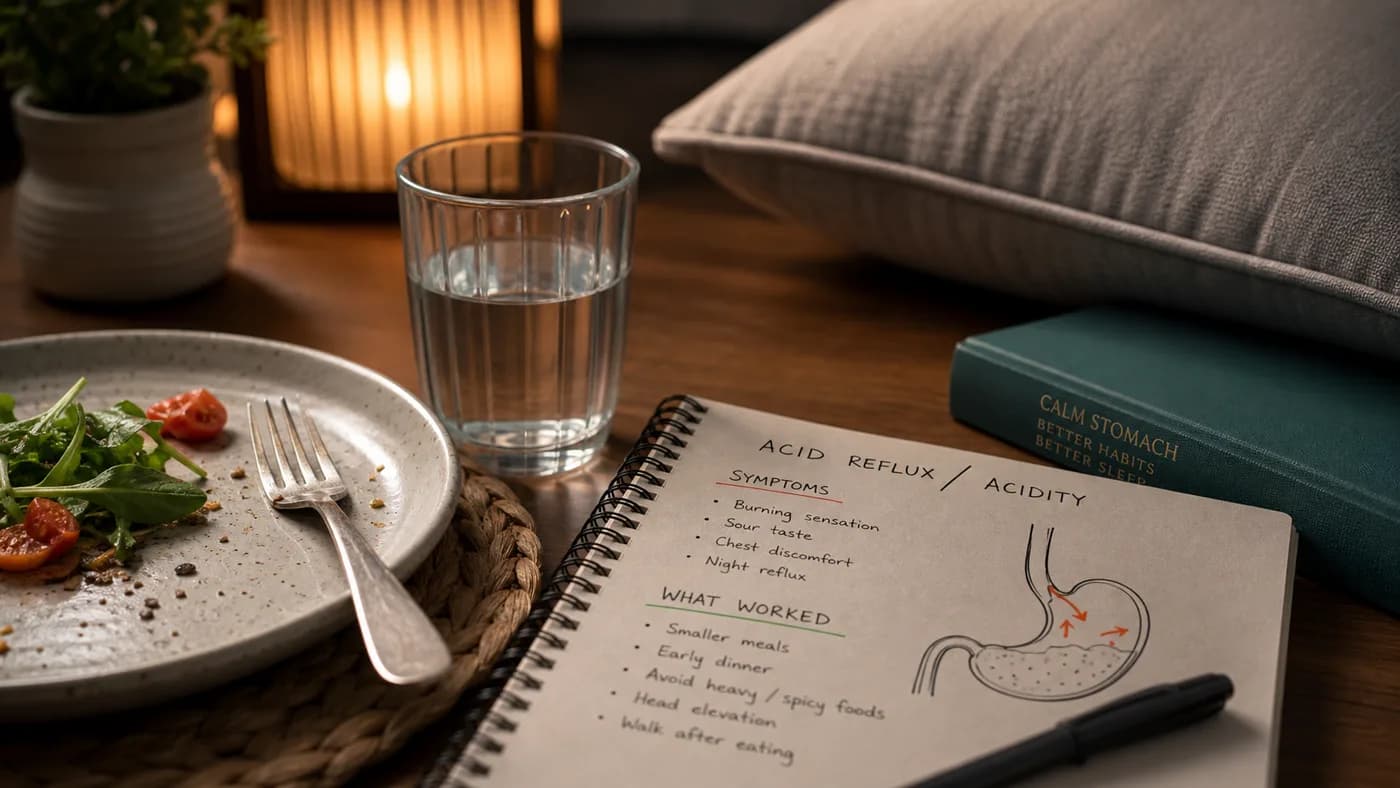
What worked (and is it clinically backed?)

Reported actions + clinician backing + whether it’s short-term relief or long-term improvement.

Chips show clinician backing and whether an action is short-term relief or long-term improvement.

Eating smaller, frequent meals reduces stomach pressure
100Clinician-backedLong-term improvement
Avoiding late-night meals reduces nighttime reflux
92Clinician-backedLong-term improvement
Elevating head during sleep reduces acid backflow
84Clinician-backedLong-term improvement
Antacids give quick symptom relief
68Mixed / contextShort-term relief
H2 blockers and PPIs reduce acid production
60Mixed / contextShort-term relief
Reference: Data methodology

Foods: reduce vs increase

Two-column food board for quick planning.

Reference: Data methodology

IncreaseShorts from HealthUnspoken

30 sec visual summary

Foods that make acid reflux worse

ReduceShorts from HealthUnspoken

30 sec visual summary

Foods that calm an acidic stomach

Reduce

Foods people often find gentle

5 items
Oats
Banana
Curd (plain)
Watermelon
Ginger

Increase

Foods people commonly limit

5 items
Fried foods
Coffee
Alcohol
Spicy foods
Carbonated drinks

Daily habits that worsen acidity — and what to do instead

If this habit worsens acidity, here’s a safer alternative.

Reference: Data methodology

Trigger

Stress / anxiety

Do instead

Eating smaller, frequent meals
Keeps stomach volume steady.

Trigger

Overeating / heavy meal

Do instead

Avoiding late-night meals
Reduces reflux while sleeping.

Trigger

Spicy / fried foods

Do instead

Choosing bland, low-fat foods
Easier on the stomach lining.

Trigger

Coffee / tea

Do instead

Reducing caffeine / avoiding empty stomach
Lowers acid stimulation.

Trigger

Lying down after meals

Do instead

Elevating head during sleep
Uses gravity to prevent reflux.

Myths vs reality

Clear fact checks in a split view.

Reference: Data methodology

Milk permanently cures acidity

Milk can feel soothing briefly

For some people it can trigger more acid later, so responses vary.

Only spicy food causes acidity

Meal timing, stress, and quantity often matter more

Spice can contribute, but it is rarely the only driver.

Acidity means excess acid only

Valve dysfunction is a common root issue

Weak LES control is frequently cited in clinician guidance.

Trade-offs and warnings

Important cautions and trade-offs to consider.

Reference: Data methodology

Lifestyle changes require long-term habit changes

Results are gradual, not instant.

Medicines are not a permanent solution

Long-term use may cause side effects.

Difficulty swallowing or chest pain needs urgent care

Seek medical evaluation for severe or sudden symptoms.

Frequent symptoms or weight loss need clinician review

Persistent reflux may signal underlying issues.

Reading notes

How to read the symptom charts

These charts show which symptoms come up most often when people describe acidity. Think of them as a snapshot, not a diagnosis.

Root-cause notes

Root causes are grouped by how clinicians typically explain reflux. More than one factor can be true at the same time.

What worked: context

This section compares what people try with what clinicians usually recommend. When they overlap, that’s a useful signal; when they don’t, use extra caution.

Foods: context

Food lists are patterns, not rules. If a food bothers you consistently, that matters more than averages.

Daily habits: context

Small habits add up. These swaps are meant to be low‑effort and easy to test for a week or two.

Myths vs reality: context

These myths show up often in comments and conversations. The reality column adds the missing context.

Trade-offs: context

If a tip sounds too good to be true, it usually is. These warnings highlight where people ran into problems or needed medical review.

How to manage acidity at night

A gentle night routine that many people find reduces reflux discomfort.

  1. Finish dinner earlier: Aim for 3–4 hours between dinner and sleep.
  2. Keep portions light: Smaller dinners are easier on the stomach.
  3. Use gravity: Elevate the head of your bed or sleep on the left side.

FAQs

Is acidity always caused by spicy food?

Not always. Meal timing, portion size, stress, and sleep position can matter just as much.

Do antacids fix the root cause?

They can reduce symptoms for many people, but they may not address underlying causes.

When should I see a doctor?

If symptoms are frequent, severe, or come with weight loss or chest pain, get medical advice.

Knowledge check

Which habit most often worsens acidity at night?

  • Late heavy meals
  • Early light dinner
  • Short walk after meals

Eating late and heavy leaves more stomach contents while lying down.

What is a common non-food contributor to acidity?

  • Stress
  • Cold showers
  • Reading before bed

Stress can increase sensitivity and disrupt digestion for many people.

Data methodology & context

This page summarizes recurring patterns from public discussions and clinician summaries. We highlight what people commonly report and where medical guidance tends to agree or caution. It is meant to help you ask better questions, not replace professional care.

We separate anecdotes (what people say helped or hurt) from clinician-backed guidance when possible. If the two disagree, we call it out clearly.

Signals analyzed: 41,479. Last updated: 2026-01-04T11:30:54.196274. Evidence level: mixed.

This content summarizes patterns from lived experiences and clinician guidance for education only. It is not medical advice.

Related topics

Keep exploring after Acidity

Bloating

Based on 10,000+ signals, bloating is described as abdominal fullness and distension. Key data identifies fermentation of FODMAPs, gut sensitivity, and slow transit as primary drivers, while movement and ACV show high success.

Constipation

A practical view of constipation patterns, common triggers, and helpful habits. Informational only; not medical advice.

Banana

Informational notes on Banana with cautious guidance and limits.

Curd (Yogurt)

Informational notes on Curd (Yogurt) with cautious guidance and limits.

Oats

Informational notes on Oats with cautious guidance and limits.

Ginger

Informational notes on Ginger with cautious guidance and limits.

PCOS (Polycystic Ovary Syndrome)

PCOS is a common hormone-related condition most often linked to irregular ovulation, higher androgen activity (acne, excess hair growth, scalp hair thinning), and metabolic features like insulin resistance. It exists on a spectrum: some people are overweight, others are not, and symptoms can vary widely.

Male infertility

Community discussions around male fertility focus on sperm quality (count, motility, morphology), semen concerns, varicocele, and hormone/sexual-function questions. The most repeated self-actions include reducing heat exposure, lifestyle changes over 2–3 months, and targeted nutrients.

Pregnancy

Pregnancy questions in real discussions cluster around diet safety (especially keto/low-carb/fasting), nausea, gestational diabetes, blood pressure concerns, thyroid changes, gallbladder/gallstones, swelling, constipation, and supplement safety. People want practical rules: what’s normal, what’s risky, and when to see a doctor.

Iron

Informational notes on Iron with cautious guidance and limits.