
Living With Metatarsus Adductus: A Lifetime of Silent Strength
- Authors

- Name
- Author: HealthUnspoken Editorial Team
- Published on
- Last updated:
- Country
- Country
- 🌍Country: USA
For most of my life, I assumed aching legs and sore feet were just part of being an active kid. I ran, jumped, swam, and kept up with everyone else, never realizing my feet were shaped differently. Decades later I learned the name: Metatarsus Adductus. Suddenly, childhood, pain, shoes, sprinting, and adaptation all belonged to the same story.
Barefoot Childhood, Quiet Pain
Shoes and I never got along.
My feet were wide in an odd place, as if the middle toes were trying to change lanes. My mother did what mothers do. She massaged my feet and calves after long days. She rubbed my back when I could not sleep. She hunted for shoes that did not pinch.
Most days she gave up and let me go barefoot.
I thought everyone’s legs and feet hurt after playing outside. I did not complain because I did not know there was anything to complain about. Pain felt ordinary, like grass stains on my knees or dust on my ankles. It belonged to the day and washed off by morning.
Until it did not.
That is one of the strange things about growing up with a body difference. If it has always been there, it can hide in plain sight. You do not call it a symptom. You call it your normal.
Gym Class and the Illusion of Normal
In junior high, during strict Kennedy-era gym classes, we swam laps, ran track, and practiced basic gymnastics.
Swimming was my favorite because the water made movement feel less like negotiation. Running was different. Give me the 50, 75, or 100-yard dash and I could fly. Ask me to run the mile and I faded to the back.
Long distance felt like running on splinters.
I chalked it up to being a sprinter. Nothing more.
Stretching was also telling, though I did not understand it then. Touch your toes. Reach and hold. Breathe. Everyone reached. I did not. Standing or sitting, my fingers hovered in the air, stubbornly short of where they were supposed to go.
Looking back, the clues were everywhere. They were just written in a language I did not know how to read.
The Snap That Changed Everything at 50
At age 50, my body finally spoke in a voice I could not ignore.
A tendon on the outside of my left ankle slipped, popped to the top of my foot, and snapped back into place so fast my mouth opened but no sound came out. It was pain, yes, but it was also shock, like tripping on a step you were sure was there.
I stood still.
The room went small.
When the world resized itself, I knew this was not just tired feet. I scheduled an appointment with a foot and ankle specialist and carried my questions into the waiting room like a stack of heavy books.
That moment did not create the problem. It exposed it.
Scans, Words, and a Name
X-rays. Scans. Careful hands tracing the outline of my bones.
The specialist spoke in precise sentences, but kindness sat behind his eyes.
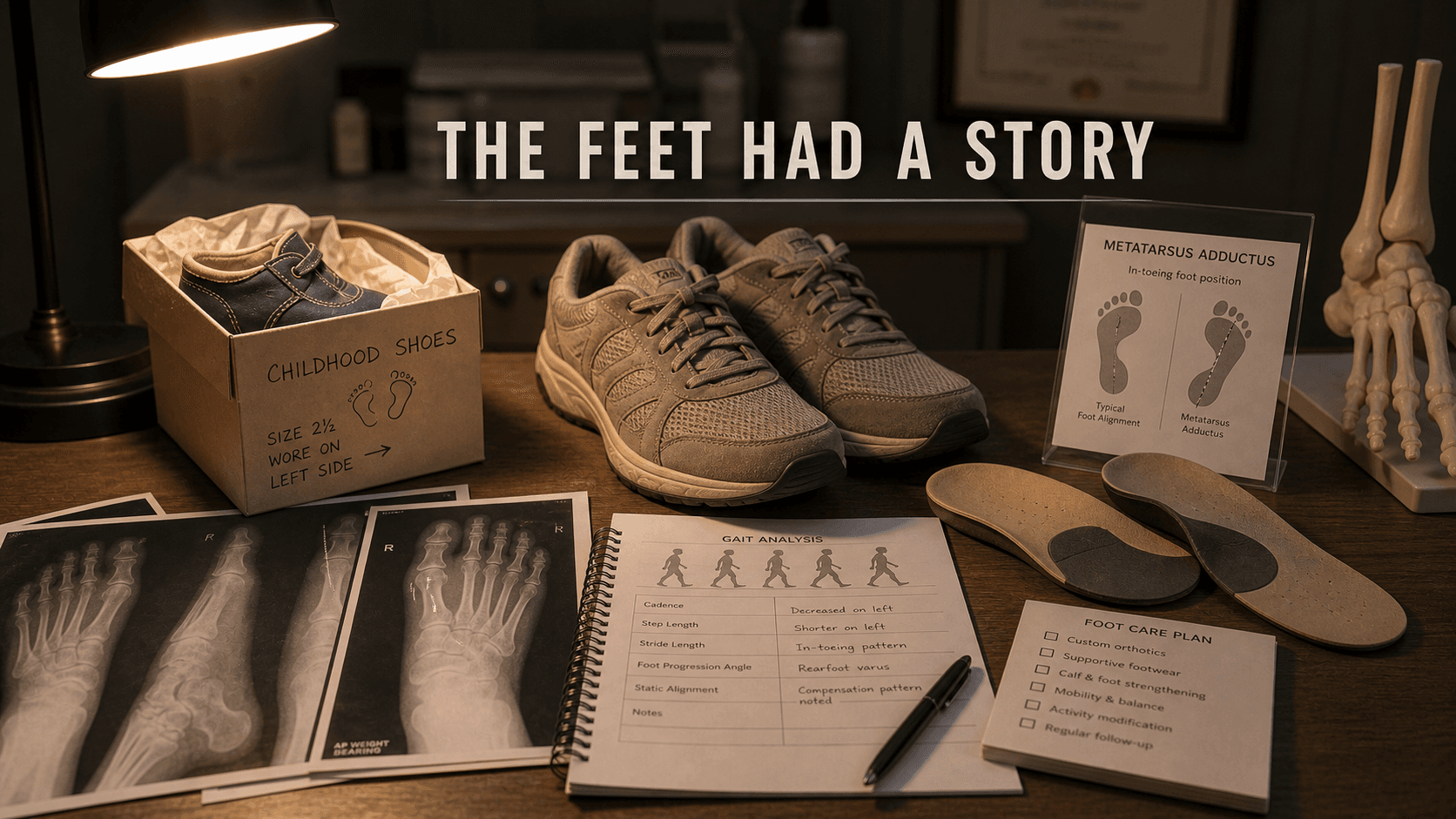
"You have the tightest Achilles tendons I have ever seen," he said, and then he showed me why my shins and calves looked like they belonged to a sprinter. My muscles had grown large to compensate for the way my feet turned in. The three middle toes on each foot zig-zagged from the ankle down, widening my feet in an unusual place.
He mentioned osteoarthritis: both feet, fingers, spine.
The picture widened. Years of compensation had left fingerprints everywhere.
Then he gave it a name: Metatarsus Adductus, likely congenital.
Cleveland Clinic describes metatarsus adductus as a congenital condition where the front part of the foot and toes curve inward. POSNA, the Pediatric Orthopaedic Society of North America, describes it as medial deviation of the forefoot relative to the hindfoot. In many babies, mild flexible cases improve on their own. More rigid or severe cases may need stretching, casting, bracing, special shoes, or, rarely, surgery.
I was not a baby receiving an early diagnosis. I was an adult finally understanding an old pattern.
For the first time, my body’s handwriting was translated.
Why Surgery Was Not the Answer
We talked through the "fix."
It was not one surgery. It was many possibilities layered together: possibly breaking bones, changing alignment, tightening what was too loose, releasing what was too tight, then recovering and seeing what the first round revealed.
And surgery would not erase the arthritis already present.
He looked at the whole of me: my age, my function, the joints already complaining, and the risks layered on top of the pain I lived with. Then he said something I did not expect from a surgeon:
“I won’t recommend this. You walk. You function. To take a woman who’s managing, even in pain, and put her through all of this would feel like malpractice.”
I respected him immediately.
Honesty is a kind of medicine. It does not numb anything, but it gives you your choices back.
AAOS OrthoInfo notes that surgery for metatarsus adductus is rarely required, especially compared with the many childhood cases that improve without major intervention. POSNA also describes surgery as rarely indicated and mainly considered in uncommon, persistent, disabling deformity.
That does not mean surgery is never right.
It means surgery has to answer the right question: What function are we protecting, what pain are we trying to reduce, and what new problems might the repair create?
What Other Foot-Pain Stories Kept Repeating
When I reviewed broader foot, ankle, orthotic, Achilles, and walking-pain conversations from doctor-channel and health-influencer comment sources, the exact diagnosis varied, but the human patterns were familiar. I am not publishing raw comments or personal details, only the themes.
People described long periods of trying to function through pain before getting podiatry or orthopedic help. Many tried shoe changes, orthotics, stretching, ice, walking boots, injections, braces, or physical therapy. Some found one intervention life-changing. Others felt worse because the advice did not match the actual problem.
Another theme was fear around tendons. People described Achilles pain, tendon rupture, ankle snaps, and delayed recognition of serious injury. That matters because "foot pain" is not one thing. Plantar fasciitis, tendon injury, nerve pain, arthritis, fracture, gait compensation, congenital alignment, and inflammatory disease can all produce pain in the same general neighborhood.
The most useful lesson was not to copy someone else’s stretch, shoe, or brace.
It was to ask what structure is actually causing the pain.
Adaptation: The Body’s Quiet Genius
Before I left, the specialist said, almost to himself, “It’s amazing how the human body compensates for a congenital abnormality like this.”
I asked if he would call it a miracle.
He smiled carefully. "Not my vernacular."
I smiled wider. "It’s mine."
That exchange stayed with me because adaptation is ordinary and wondrous at the same time. My body found workarounds: big calves to steady me, stubborn arches to hold me up, habits that let me walk flat-footed and straight ahead.
Not perfect.
But forward.
There is a danger, though, in romanticizing adaptation. Compensation can keep you moving, but it can also overload other joints. Pain in one place may change how you use the ankle, knee, hip, back, or opposite foot.
That is why I now think of adaptation as something to respect, not something to ignore.
Living With Pain Without Letting It Have Me
I am 66 now.
Pain and I share a small house.
The arches complain. The shins and calves sing their old song. My hands, elbows, and curved spine add their harmonies. Some days the chorus is loud. Other days it is background music and I go about my life.
People who pass me on the sidewalk see a "normal" woman, a few inches shorter than I might have been. They do not see the negotiation happening with every step.
That is fine.
The deal is between me and my body.
What helps me is practical and imperfect:
- shoes I can actually trust, even if they are not pretty
- support that fits the foot I have, not the foot I wish I had
- stretching that respects limits
- calf releases, gentle ankle circles, and slow toe spreads when appropriate
- heat on stubborn mornings
- ice on angry evenings
- short, purposeful walks instead of heroic distances
- rest without guilt
- humor, because it keeps the day from becoming only medical
This is not a cure list. It is a way of staying in conversation with a body that has been adapting for decades.

Questions I Would Ask Sooner
If I could hand my younger self a list, I would not tell her to panic.
I would tell her to ask better questions earlier.
- Why do my feet hurt more than other people’s feet after the same activity?
- Is my gait causing compensation in my ankles, knees, hips, or back?
- Are my Achilles tendons tight because of foot shape, muscle pattern, or another issue?
- Would supportive shoes, orthotics, or physical therapy help my specific mechanics?
- Are there signs of arthritis, tendon irritation, nerve pain, or stress injury?
- What activities are helpful, and which ones are overloading the same structure?
- If surgery is discussed, what is the realistic goal and recovery burden?
The goal is not to turn every childhood ache into a medical emergency. It is to notice when a pattern keeps repeating.
Faith, Language, and Gratitude
I keep thinking about language: his and mine.
He had the language of training, scans, and measurements. I had the language of prayer and gratitude. We both told the truth, just in different dialects.
When I say God is good, I do not mean the pain vanished.
I mean I have been given the strength to carry it. I mean my mother’s hands massaging my legs in a kitchen that smelled like soap. I mean a surgeon choosing restraint. I mean the ordinary miracle of standing upright and moving forward, again and again.
Faith did not replace medical care for me.
It helped me live inside the uncertainty without becoming only the diagnosis.
When to Seek Medical Care
Please seek medical evaluation for foot, ankle, leg, or gait problems if pain is persistent, worsening, limiting walking, changing your balance, or causing repeated falls.
Seek prompt care if you have:
- sudden severe foot or ankle pain after a pop, snap, fall, or twist
- inability to bear weight
- new deformity, major swelling, bruising, or warmth
- numbness, tingling, weakness, or loss of function
- wounds, redness, drainage, fever, or signs of infection
- pain that wakes you at night or keeps worsening despite rest
- diabetes, circulation problems, immune suppression, or known neuropathy
- a child with rigid foot curvature, pain, limp, delayed walking, or concerns about hip development
If surgery is being considered, ask about non-surgical options, realistic recovery, arthritis, complication risk, rehabilitation time, and what function the procedure is expected to improve.
Final Reflections
Metatarsus adductus did not ruin my life.
It shaped it.
It drew a border around what I could do comfortably and asked me to build something beautiful inside those lines. Would a stack of surgeries have redrawn the map? Maybe. But the life I have lived: swimming hard, sprinting fast, walking straight, laughing often, fits me like the one pair of shoes that finally does.
I still live with pain.
I also live with resilience.
Both are true. Both belong.
And when I look at the long arc from barefoot childhood to this morning’s careful first steps, I feel something deeper than explanation.
Call it adaptation. Call it grace.
I call it a miracle.
Related Reading
References
- Cleveland Clinic: Metatarsus Adductus
- AAOS OrthoInfo: Intoeing
- POSNA: Metatarsus Adductus
- Johns Hopkins Medicine: Metatarsus Adductus
Disclaimer: This article is for educational purposes only and is not medical advice. Individual symptoms, risks, and treatment decisions vary. Always consult a qualified healthcare professional for diagnosis and personalized care. If you have severe, worsening, or emergency symptoms, seek urgent medical attention immediately.
Related Reading
Continue reading after Living With Metatarsus Adductus: A Lifetime of Silent Strength

I Kept Pushing Through the Pain… Until It Took Everything From Me
A personal journey through years of untreated back pain, difficult decisions, and the emotional reality of living with sciatica and surgery aftermath.
Two Hip Replacements, Twenty Years Apart and the Quiet Miracle of Living Without Pain
I lived through two hip replacements separated by twenty years. What changed was not only medicine but how pain, preparation, therapy and resilience reshaped my life.

Four Collapsed Lungs, Years of Misdiagnosis — My Life With Ehlers-Danlos Syndrome
A personal journey through repeated lung collapses, surgery, medical dismissal, rib instability, infections, and finally receiving an Ehlers-Danlos Syndrome diagnosis.
Share on WhatsApp
2–3 line summary is copied. Tap to open WhatsApp and share.
 Tip: You can edit the text after it opens in WhatsApp.
Editorial Note
This article is prepared by the HealthUnspoken Editorial Team. Our articles may combine first-person submissions, public health education references, and commonly discussed experiences, then are edited for clarity and context.
The goal is reader awareness and education. This content is not a diagnosis or a treatment plan.
⚕️ Medical Disclaimer
The information provided in this article is for **educational and informational purposes only**. It should not be considered medical advice, diagnosis, or treatment. Always seek the advice of your physician or other qualified healthcare provider regarding any medical condition or treatment decisions.
🧾 Sources
HealthUnspoken articles may include first-person stories, editorial summaries of broadly discussed experiences, and public health education references. They are reviewed by the editorial team for clarity and educational context.
Reader Experiences Shared
Curated anonymized snippets from public health discussions, edited for readability.
I kept thinking metatarsus adductus would settle on its own, but what helped most was tracking patterns and asking clearer questions in appointments.
The hardest part for me was uncertainty around metatarsus adductus. Once I stopped changing everything at once, I could finally see what was helping.
I used to delay care because I was embarrassed about metatarsus adductus. Earlier conversations would have saved me a lot of stress.
A second opinion around metatarsus adductus changed my decisions completely. The issue was still real, but the plan felt calmer and more practical.
For me, progress with metatarsus adductus came from boring consistency, not one dramatic fix. That mindset reduced panic a lot.
I learned to separate fear from facts with metatarsus adductus. Writing down symptoms before visits made discussions more useful.