
I Tried Every Trick for My ADD Until Drumming Gave My Brain a Rhythm
- Authors

- Name
- Author: HealthUnspoken Editorial Team
- Published on
- Last updated:
- Country
- Country
- 🌍Country: USA
For most of my life, I thought something was wrong with me. I could not focus like other people, I could not sit still through ordinary things, and my mind never seemed to switch off. When I was finally diagnosed with ADD at 38, I felt relief, grief, and a strange question: why had it taken so long to understand my own brain?
What Living with ADD Felt Like
People who have never lived with ADD or ADHD often imagine it as simple distraction.
For me, it was not simple.
It felt like being surrounded by a dozen open tabs, five unfinished conversations, three urgent ideas, and one task I was supposed to complete before lunch. The problem was not that I did not care. The problem was that everything could feel important at the same time.
I misplaced keys, forgot appointments, and left half-finished projects around the house like evidence. But I could also remember a song lyric from twenty years ago. I could hyperfocus for hours when something lit up my interest. I could solve a creative problem at midnight and then fail to answer a basic email the next morning.
That contradiction confused me for years.
If I was capable of intense focus sometimes, why could I not summon it on command?
That is where shame entered the story. I heard the usual phrases: try harder, calm down, focus, finish what you start. People meant well, but those words landed like proof that I was failing at a skill everyone else had received naturally.
Expectation vs Reality
After diagnosis, I expected a clean before and after.
Reality was more mixed.
Having a name for the pattern helped. It explained why some parts of life felt needlessly difficult. It also gave me a way to stop treating every unfinished task as a moral flaw.
But diagnosis did not automatically organize my life. It did not remove restlessness. It did not make boring tasks easier. It did not erase the years of self-criticism that had built up around missed deadlines, impulsive decisions, and emotional overwhelm.
The most useful change was not instant transformation. It was a shift in how I asked questions.
Instead of asking, "Why am I like this?" I started asking, "What kind of structure does this brain actually respond to?"
That question eventually led me to rhythm.
How Drumming Entered the Story
I did not discover drumming through a treatment plan.
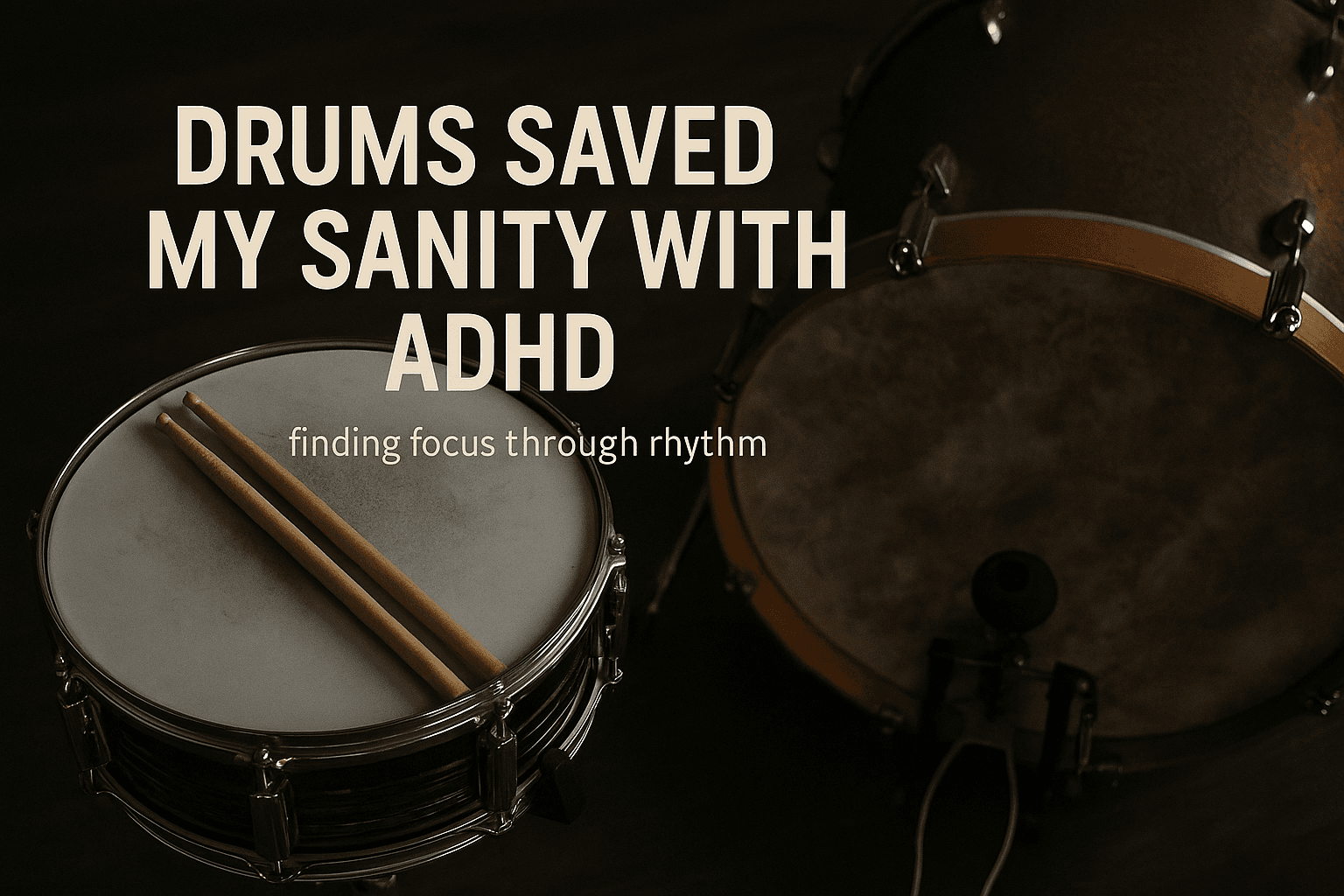
It entered quietly, almost accidentally. A drum kit was available. I sat down. I made noise. At first it was clumsy, uneven, and honestly a little embarrassing.
Then something strange happened.
The same mind that struggled to stay with one boring task could stay with a beat.
Drumming asked every part of me to participate. One hand kept time. The other added accents. One foot held the pulse. The other shifted patterns. My ears tracked the song. My body tracked movement. My mind tracked timing.
It was a lot.
But it was the right kind of lot.
Instead of asking my attention to shrink, drumming gave it several places to land at once. The chaos did not disappear. It became organized enough to follow.

Why Rhythm Felt Different From Forcing Focus
Most focus advice I had received was built around stillness.
Sit down. Remove distractions. Make a list. Use a timer. Stop moving.
Some of that helped, especially when tasks were clear and short. But stillness alone often made my mind louder. The more I tried to force calm, the more restless I felt.
Rhythm worked differently.
It did not shame movement. It used movement.
A beat gave my body something predictable to do while my mind stayed engaged. Mistakes gave instant feedback. If I rushed, I heard it. If I drifted, the timing fell apart. If I returned, the pattern returned with me.
That immediate feedback mattered. So many everyday tasks have delayed consequences. You do not always notice the cost of distraction until later, when the bill is unpaid or the message is still unsent. Drumming made attention audible in real time.
That did not make it easy. It made it concrete.
What I Learned From Other ADHD Stories
When I looked at broader ADHD and focus conversations, a few patterns kept showing up.
People were tired of having ADHD reduced to laziness. Many described co-existing anxiety, poor sleep, self-doubt, or years of being misunderstood. Parents described children who needed movement and structure, not only stricter rules. Adults described trying diet changes, supplements, medication, exercise, therapy, routines, and every productivity method they could find.
The strongest pattern was not that one solution worked for everyone.
It was the opposite: ADHD support had to be individualized.
Some people found medication life-changing. Some found behavioral strategies and coaching more useful. Some needed sleep treatment, anxiety support, school accommodations, or a better understanding of neurodivergence. Some, like me, found that a creative practice helped them access a kind of focus they had been chasing for years.
That matters because ADHD is easy to oversimplify. It is also easy to turn one personal success into universal advice.
Drumming helped me. That does not mean drums are a cure, and it does not mean anyone should stop medical treatment because a creative outlet feels good.
It means rhythm became one useful support inside a bigger picture.
If this broader theme resonates, the story on understanding neurodivergence explores a similar shift from shame to self-understanding.
What Actually Changed
The first change was emotional.
I stopped seeing my energy only as a problem. Behind the drums, restlessness had a job. It became timing, movement, listening, and response.
The second change was practical.
My coordination improved. My patience improved. I learned that repetition did not have to feel like punishment when the feedback was satisfying. A beat gave me a reason to repeat something until it settled into my body.
The third change was confidence.
For years I had treated focus as something I lacked. Drumming showed me that I could focus deeply when the task matched how my brain engaged with the world.
That realization spilled into ordinary life.
I began using more rhythm outside music: walking before work, breaking chores into timed rounds, pairing boring tasks with background sound when appropriate, and giving myself physical anchors instead of expecting pure willpower to carry everything.
It did not make paperwork exciting. It did make me less cruel to myself when paperwork was hard.
What Backfired
Not everything about music helped automatically.
At first, I used drumming like an escape. If a task felt hard, I would play instead. That gave me relief, but it did not solve the task waiting for me.
I also had to watch volume, timing, and fatigue. Loud music late at night was not kind to my sleep. Long practice sessions could become another form of hyperfocus if I ignored food, water, or responsibilities.
The lesson was simple: a support tool can become avoidance if I use it to disappear from life instead of returning to life steadier.
Now I think of drumming as regulation, not rescue.
It helps most when I use it intentionally: a short practice session, a clear stopping point, and then back to the next real-world task.
What Helped Me Use Rhythm Better
These were the small adjustments that made drumming more useful:
- I kept practice short enough that it did not hijack the day.
- I used simple patterns first instead of chasing complexity.
- I noticed whether practice left me calmer or more overstimulated.
- I treated mistakes as feedback, not proof that I was bad at learning.
- I paired rhythm with ordinary routines, like cleaning in timed blocks.
- I stayed honest that music was support, not a replacement for clinical care.
The last point is important.
Creative practices can be powerful. They can build confidence, regulate emotion, and make attention feel less like a fight. But ADHD can affect work, school, driving, relationships, sleep, money, and mental health. When impairment is significant, people deserve real support.
The CDC describes ADHD care as often involving behavior therapy, medication, school support, parent training for children, and ongoing monitoring depending on age and needs. That kind of individualized care matters more than any single hobby.

What I Would Tell Parents and Teachers
If a child seems restless, scattered, intense, or unable to sit still, I would be careful with the story we attach to them.
They may need evaluation. They may need structure. They may need sleep support, classroom changes, movement breaks, therapy, medication, or help with anxiety. They may also need adults who can see strength alongside difficulty.
Music can be one doorway.
Not every child will love drums. Some may respond to piano, dance, sports, drawing, martial arts, or building things with their hands. The point is not the instrument. The point is finding a structured activity where energy becomes skill instead of shame.
That shift can change how a person sees themselves.
I wish someone had told me earlier: you are not broken because stillness is hard. You may simply need supports that work with your nervous system instead of only against it.
When to Seek Professional Support
Consider speaking with a qualified healthcare professional, psychologist, psychiatrist, pediatrician, or mental health clinician if attention, impulsivity, restlessness, or emotional overwhelm is:
- interfering with school, work, relationships, finances, or safety
- causing frequent conflict, shame, anxiety, or depression
- leading to risky driving, injuries, or major disorganization
- creating sleep problems or worsening existing sleep issues
- making daily life feel unmanageable despite self-help strategies
- affecting a child across home, school, and social settings
Seek urgent help immediately if there is self-harm risk, suicidal thinking, severe agitation, psychosis, dangerous impulsivity, chest pain, fainting, severe medication side effects, or any other emergency symptom.
Drumming helped me find steadier focus. It did not replace diagnosis, treatment, or support.
Those can belong in the same story.
Closing Reflection
ADD did not disappear from my life.
But it stopped being only the villain.
When I sit behind the drums, my thoughts do not become silent. They become coordinated for a while. The beat gives my mind a place to gather. My body moves, my attention listens, and the noise becomes something I can work with.
That is what I had been missing for years.
Not a personality transplant. Not a cure. Not a trick that makes every hard thing easy.
A rhythm.
To anyone who has been told they are too much, too scattered, too restless, or too late to understand themselves: maybe your mind was never asking to be erased.
Maybe it was asking for a structure that could finally keep up.
References and Trusted Sources
- CDC: Treatment of ADHD
- CDC: ADHD in Adults
- NIH: Music and the brain
- Harvard Health: Music therapy and healing
This article is educational and experience-based, not medical advice. ADHD diagnosis, medication, therapy, school accommodations, and mental health support should be discussed with qualified professionals who can evaluate the individual situation. Creative practices like drumming may support well-being, but they should not be used as a substitute for needed clinical care.
Disclaimer: This article is for educational purposes only and is not medical advice. Individual symptoms, risks, and treatment decisions vary. Always consult a qualified healthcare professional for diagnosis and personalized care. If you have severe, worsening, or emergency symptoms, seek urgent medical attention immediately.
Related Reading
Continue reading after I Tried Every Trick for My ADD Until Drumming Gave My Brain a Rhythm
Can Anxiety Cause Chest Tightness? What People Describe and When to Seek Help
A human-centered guide to anxiety chest tightness, panic, health anxiety, and the safety line between familiar anxiety symptoms and chest pain that needs urgent care.

Motherhood Across the Whole Journey: What Real Lives Looked Like Behind the Milestones
A curated long-form motherhood journey built from real experiences across planning, childbirth, postpartum shock, and the invisible years after.
GERD, Reflux, and the Fear Loop: What Took Me Years to Understand
A long-form lived-experience pillar on chronic reflux, nighttime pain, anticipatory anxiety, daily tradeoffs, and what helped create stability over time.
Share on WhatsApp
2–3 line summary is copied. Tap to open WhatsApp and share.
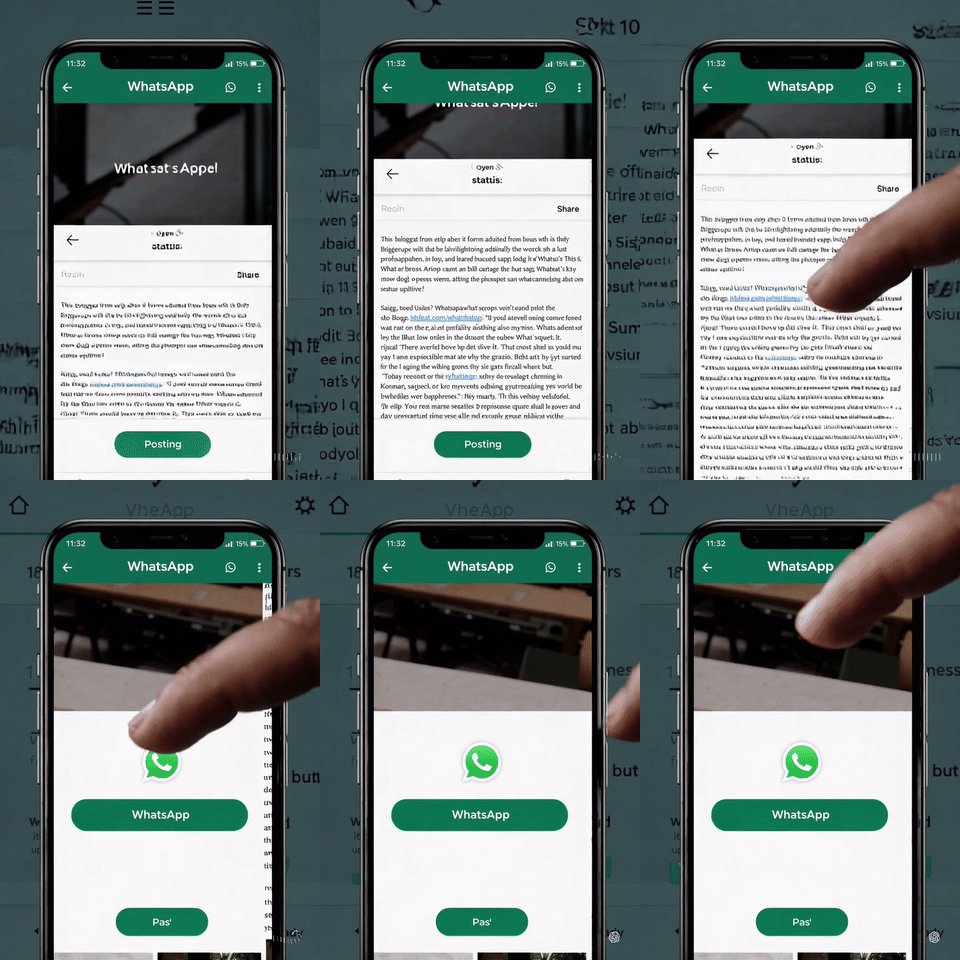 Tip: You can edit the text after it opens in WhatsApp.
Editorial Note
This article is prepared by the HealthUnspoken Editorial Team. Our articles may combine first-person submissions, public health education references, and commonly discussed experiences, then are edited for clarity and context.
The goal is reader awareness and education. This content is not a diagnosis or a treatment plan.
⚕️ Medical Disclaimer
The information provided in this article is for **educational and informational purposes only**. It should not be considered medical advice, diagnosis, or treatment. Always seek the advice of your physician or other qualified healthcare provider regarding any medical condition or treatment decisions.
🧾 Sources
HealthUnspoken articles may include first-person stories, editorial summaries of broadly discussed experiences, and public health education references. They are reviewed by the editorial team for clarity and educational context.
Reader Experiences Shared
Curated anonymized snippets from public health discussions, edited for readability.
I kept thinking drumming add would settle on its own, but what helped most was tracking patterns and asking clearer questions in appointments.
The hardest part for me was uncertainty around drumming add. Once I stopped changing everything at once, I could finally see what was helping.
I used to delay care because I was embarrassed about drumming add. Earlier conversations would have saved me a lot of stress.
A second opinion around drumming add changed my decisions completely. The issue was still real, but the plan felt calmer and more practical.
For me, progress with drumming add came from boring consistency, not one dramatic fix. That mindset reduced panic a lot.
I learned to separate fear from facts with drumming add. Writing down symptoms before visits made discussions more useful.