
The Scan Said More Than I Was Ready to Understand
- Authors

- Name
- Author: HealthUnspoken Editorial Team
- Published on
- Last updated:
- Country
- Country
- 🌍Country: India
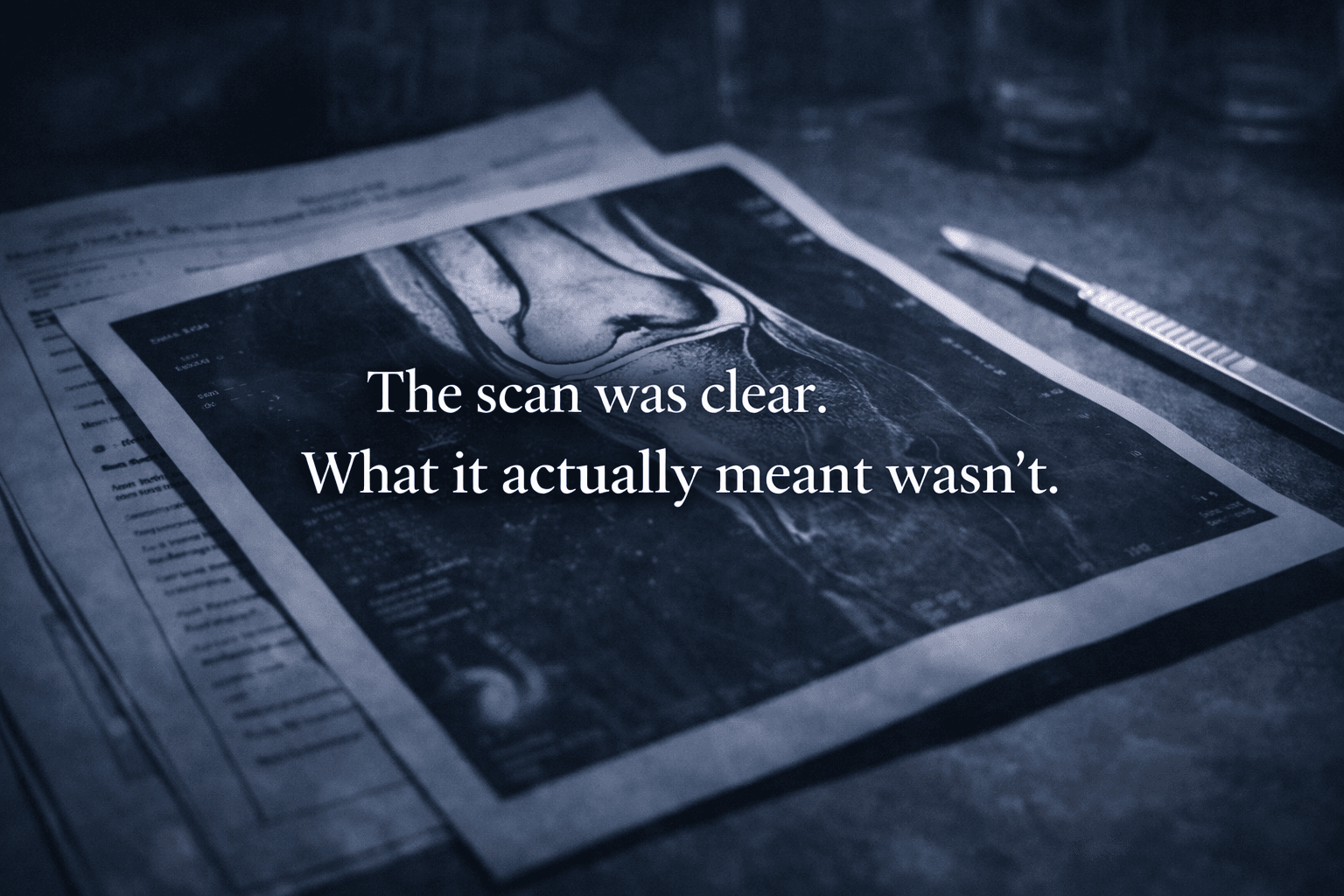
I did not go looking for surgery. I went looking for relief. What I found instead was a knee MRI report filled with words that sounded far worse than the pain I was actually living with.
Living With a Knee That Was Never Quite Right
I had trouble with that knee for years.
Nothing dramatic at first. Nothing that made me stop everything and rush for help. Just a persistent ache that came and went, and a swelling behind the knee that had been there so long it almost became part of my normal.
Sometimes it grew. Sometimes it shrank. Sometimes it behaved.
And sometimes it did not.
I stayed active anyway. Cycling. Snowboarding. Moving the way I always had. The knee complained, but it did not truly stop me.
Until it did.
Expectation vs Reality
The expectation was that imaging would make everything clearer.
The reality was more complicated.
An X-ray can feel simple: either something obvious is there, or it is not. An MRI feels different. It sees more. It names more. It can show tears, fluid, cartilage changes, degeneration, old injury, and little findings that may or may not explain the pain you feel that day.
That is useful. It is also overwhelming.
I wanted the scan to give me a clean answer. Instead, it gave me a page of medical language and a new kind of anxiety: what does this actually mean for my life?
When Pain Finally Pushed Me to Get Answers
Eventually, the discomfort wore me down enough to ask for imaging.
First came an X-ray. Then an MRI.
The early results were not treated like an emergency. There was fluid, wear, and a plan that sounded measured: try an injection, calm things down, then consider a series meant to support the joint if the first step helped.
That felt reasonable. Conservative. Controlled.
Then life did what it often does. It interrupted the plan.
The Ordinary Moment That Changed Everything
It happened during something ordinary.
I was cleaning my truck, standing on the running board, reaching across the hood. My grip slipped. I stepped back without thinking.
The moment my right foot hit the ground, I felt it.
A pop.
Not subtle. Not questionable. Loud, sharp, and final.
I had torn an ACL in that same knee years before, so my mind went straight there. I imagined months of recovery, loss of mobility, and the end of activities I loved.
An X-ray showed nothing obvious. The MRI told a more detailed story.
The Language That Sounds Worse Than the Injury
The report was filled with phrases that looked intimidating on paper.
Complex tearing. Posterior horn. Degenerative changes. Joint effusion. Chondromalacia.
Words stacked on words.
I read them slowly, trying to translate them into something I could actually feel in my body. But MRI reports are not written like patient conversations. They are written for clinicians, with compressed language that assumes someone else will explain the meaning.
That gap can be emotionally brutal.
When you are the person living inside the body being described, a phrase like "complex tear" does not stay neutral. It becomes a future. It becomes a fear. It becomes a question you carry into the next appointment.

What Similar Knee Stories Often Reveal
Across knee-pain and injury conversations, a few patterns repeat. I am not publishing raw comments or personal details here, but the themes are useful.
Some people are not afraid of the MRI itself; they are afraid of what the report might mean. Others describe the scan experience as surprisingly stressful because of claustrophobia, noise, cost, or insurance delays. Some finally get imaging after weeks or months of being told to wait, rest, or try therapy first.
There is also a recovery pattern that shows up again and again: physical therapy is not a consolation prize. For many injuries, it is the actual work. Even people who choose surgery still talk about rehab as the thing that determines whether confidence comes back.
The hardest theme was psychological. People who had torn an ACL or injured a knee often described trusting the joint less afterward. The body may heal, but the mind remembers the pop, the collapse, or the moment confidence disappeared.
That helped me name what I was feeling. I was not only deciding what to do with a meniscus tear. I was trying to rebuild trust in a knee that had already failed me once.
Choosing Surgery Without Panic
When I met my orthopedic surgeon, the recommendation was clear.
Surgery made sense.
Not because the scan meant disaster. Not because every meniscus tear automatically needs surgery. But because of my symptoms, my history, my goals, and the way I wanted to live.
That distinction matters. A meniscus tear is not one single story. Some tears are treated without surgery. Some are watched. Some are supported with physical therapy, activity modification, bracing, or injections. Some may need arthroscopic surgery depending on the tear pattern, mechanical symptoms, age, arthritis, function, and response to conservative care.
I trusted this surgeon. He had rebuilt my ACL over a decade earlier, and that knee had carried me through years of activity since.
I was not interested in sitting on the sidelines waiting for life to shrink slowly. If there was a reasonable option to restore function and keep moving, I wanted to understand it.
Aging Without Surrendering Movement
There is a strange expectation that comes with age.
That you should accept limitation. That you should "slow down." That pain is just part of the deal.
I do not buy that completely.
Yes, bodies age. Joints wear. Cartilage changes. Recovery can take longer. Not every activity stays available in the same way forever.
But accepting reality is not the same as giving up motion.
Sometimes the mature decision is to modify. Sometimes it is to strengthen. Sometimes it is to stop doing the one movement that keeps provoking pain. Sometimes it is to choose surgery because the tradeoff makes sense for your life.
The point is not to pretend the body is new. The point is to make informed decisions instead of fear-based ones.
The Real Frustration Was Not Knowing
The hardest part was not deciding on surgery.
It was understanding what was happening inside my knee.
My surgeon was skilled. I do not doubt that. But explanation was not his strength.
I did not want vague reassurance. I did not want someone to tell me, "Do not worry," while I still had no idea what the report meant.
I wanted someone to explain:
- which finding matched my symptoms
- which finding was old wear and tear
- whether the tear was likely repairable or more likely trimmed
- what surgery could realistically improve
- what surgery could not promise
- how physical therapy fit before and after the decision
- what recovery would actually look like week by week
That kind of explanation changes the emotional weight of a diagnosis.
Finding Clarity Outside the Clinic
Oddly enough, clarity did not come from the exam room.
It came from a video.
A calm, well-explained breakdown of meniscus tears helped me understand how they happen, how tear patterns differ, and why a report can sound frightening without meaning the knee is hopeless.
The MRI language became less mysterious. Not less real. Not less serious. Just less frightening.
Understanding did not remove the injury, but it removed some of the fear around it.
That is why plain-language medical education matters. It does not replace a clinician. It helps a patient walk into the next appointment with better questions.
What Helped Me Think Clearly
The most useful shift was separating the scan from the decision.
The scan showed structure. The decision had to include function.
Could I walk normally? Did the knee lock or catch? Was there swelling after activity? Did stairs hurt? Did I trust the knee on uneven ground? Was pain limiting sleep, work, travel, or exercise? Had conservative treatment been tried long enough? Was arthritis part of the picture?
Those questions helped more than staring at medical terms alone.
I also started thinking about recovery as a plan, not a vague hope:
- what pain control would look like
- when weight-bearing would be allowed
- what physical therapy would focus on
- when swelling should improve
- what activities needed to wait
- what warning signs should prompt a call
- what "successful recovery" meant for my actual life

What People Slowly Realize About Knee Recovery
Knee recovery is rarely just one event.
It is not only the injury. It is the scan, the explanation, the decision, the waiting, the procedure if there is one, the swelling, the exercises, the fear of re-injury, and the patience required to trust the joint again.
That is why "just rest" can feel dismissive, and "just have surgery" can feel too simple.
The body needs a plan. The mind needs context.
For me, the goal was not a perfect knee. It was function, stability, confidence, and enough trust to keep living actively.
Questions I Would Ask Sooner
If I were going through the first appointment again, I would ask more directly:
- Is this tear traumatic, degenerative, or a mix of both?
- Does the MRI finding match my symptoms?
- Is there arthritis or cartilage damage that changes expectations?
- What are the non-surgical options, and how long should they be tried?
- What would surgery actually do: repair, trim, clean up, or something else?
- What are the risks of waiting?
- What are the risks of operating?
- What does recovery look like for someone my age and activity level?
- What signs after injury or surgery should make me call immediately?
Those questions are not confrontational. They are the beginning of informed consent.
When to Seek Medical Care
Knee pain after a twist, pop, fall, or sudden swelling deserves medical attention, especially if the knee does not settle.
Seek prompt medical care if you have:
- inability to bear weight
- obvious deformity
- major swelling after injury
- a locked knee that cannot fully bend or straighten
- severe pain, fever, redness, or warmth around the joint
- numbness, weakness, or loss of circulation signs in the leg or foot
- calf swelling, calf pain, chest pain, or shortness of breath after injury or surgery
- worsening symptoms despite rest and basic care
Also seek review if pain keeps returning, activity becomes limited, or an MRI report leaves you unclear about what is actually driving your symptoms. Imaging should lead to a conversation, not a lonely guessing game.
Related Reading
- Living With Mysterious Back Pain: My 20-Month Search for Relief
- Two Hip Replacements, Twenty Years Apart and the Quiet Miracle of Living Without Pain
References
Disclaimer: This article is for educational purposes only and is not medical advice. Individual symptoms, risks, and treatment decisions vary. Always consult a qualified healthcare professional for diagnosis and personalized care. If you have severe, worsening, or emergency symptoms, seek urgent medical attention immediately.
Related Reading
Continue reading after The Scan Said More Than I Was Ready to Understand

Two Hip Replacements, Twenty Years Apart and the Quiet Miracle of Living Without Pain
I lived through two hip replacements separated by twenty years. What changed was not only medicine but how pain, preparation, therapy and resilience reshaped my life.
I Didnt Heal Until I Finally Had Time to Heal
A de-identified personal story about chronic pain, constant work urgency, burnout, nervous-system exhaustion, and the slower kind of recovery that only started once rest became real instead of theoretical.

Living With a Dry Mouth, Burning Pain, and No Easy Answers
A lived experience of chronic dry mouth, burning pain, medication side effects, dental damage, broken sleep, and the slow search for safer support.
Share on WhatsApp
2–3 line summary is copied. Tap to open WhatsApp and share.
 Tip: You can edit the text after it opens in WhatsApp.
Editorial Note
This article is prepared by the HealthUnspoken Editorial Team. Our articles may combine first-person submissions, public health education references, and commonly discussed experiences, then are edited for clarity and context.
The goal is reader awareness and education. This content is not a diagnosis or a treatment plan.
⚕️ Medical Disclaimer
The information provided in this article is for **educational and informational purposes only**. It should not be considered medical advice, diagnosis, or treatment. Always seek the advice of your physician or other qualified healthcare provider regarding any medical condition or treatment decisions.
🧾 Sources
HealthUnspoken articles may include first-person stories, editorial summaries of broadly discussed experiences, and public health education references. They are reviewed by the editorial team for clarity and educational context.
Reader Experiences Shared
Curated anonymized snippets from public health discussions, edited for readability.
I kept thinking knee mri meniscus would settle on its own, but what helped most was tracking patterns and asking clearer questions in appointments.
The hardest part for me was uncertainty around knee mri meniscus. Once I stopped changing everything at once, I could finally see what was helping.
I used to delay care because I was embarrassed about knee mri meniscus. Earlier conversations would have saved me a lot of stress.
A second opinion around knee mri meniscus changed my decisions completely. The issue was still real, but the plan felt calmer and more practical.
For me, progress with knee mri meniscus came from boring consistency, not one dramatic fix. That mindset reduced panic a lot.
I learned to separate fear from facts with knee mri meniscus. Writing down symptoms before visits made discussions more useful.