
Why Shaming Smokers Never Worked — and What Actually Might
- Authors

- Name
- Author: HealthUnspoken Editorial Team
- Published on
- Last updated:
- Country
- Country
- 🌍Country: Global
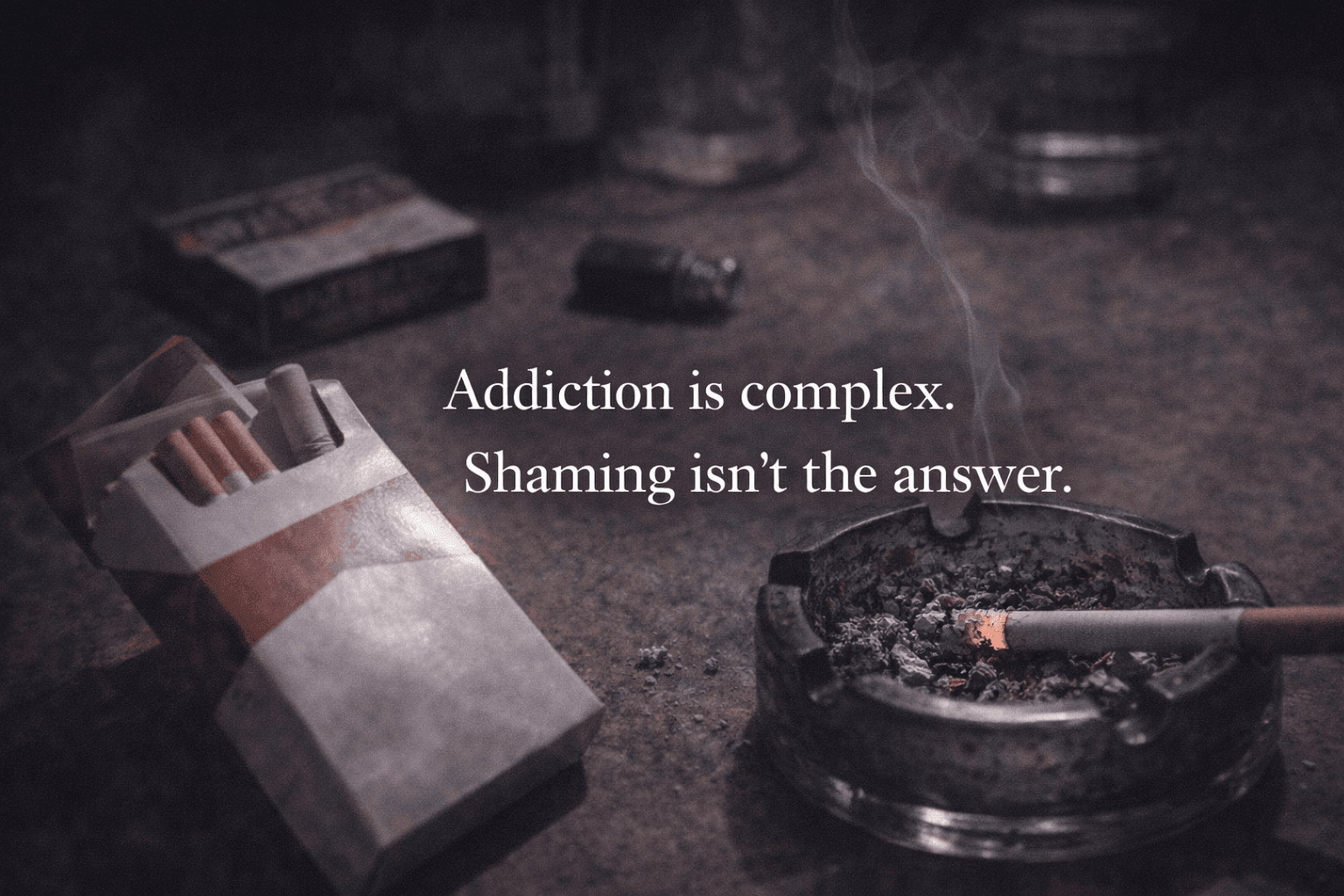
Most people already know smoking is harmful. That part of the conversation has been settled for a long time. And yet many people still smoke, not because they are unaware, careless, or morally weak, but because nicotine addiction, stress, identity, habit, environment, and access to support are more complicated than a warning label.
The Myth That Knowledge Alone Changes Behavior
There is a quiet assumption baked into how society talks about smoking:
If people know it is bad, they will stop.
If that were true, smoking would have disappeared as soon as the risks became widely known. It did not.
People smoke despite knowing the risks because knowledge does not automatically cancel addiction, routine, stress relief, social belonging, family modeling, withdrawal symptoms, or the fear of failing again.
That does not make smoking harmless. It is not harmless. CDC describes cigarette smoking as a major public health concern and says it harms nearly every organ of the body. Quitting is one of the most important health steps a person can take.
But the way we talk about quitting matters.
If the conversation begins and ends with "you should know better," it misses the part where people already do know better and still feel trapped.
Why Shame Feels Powerful but Fails
Shaming smokers can feel satisfying from the outside. It creates the illusion of moral clarity:
I know better. You should too.
But shame rarely builds the conditions needed for change.
When people feel judged, they often:
- hide the behavior
- avoid asking for help
- smoke in secret
- internalize failure
- stop believing another quit attempt is worth trying
That is the opposite of support.
Many people who smoke already carry guilt. They know the smell. They know the cough. They know the money spent. They know the fear that comes after a health scare. They know what loved ones think.
Adding humiliation to that pile usually does not produce courage. It produces isolation.
And isolation is a dangerous place to fight addiction.
Smoking Is Not Only a Choice in the Moment
For many people, smoking begins before it feels like a fully conscious adult decision.
Parents smoked. Grandparents smoked. Friends smoked. Coworkers smoked. Smoke breaks became social rituals. Cigarettes became part of boredom, grief, celebration, stress, loneliness, and routine.
The first cigarette may be social.
The hundredth may be automatic.
The thousandth may feel like part of identity.
That is why "just stop" lands so poorly. It treats smoking like one behavior, when for many people it has become a bundle of behaviors:
- morning routine
- coffee ritual
- work break
- driving habit
- emotional regulation
- social connection
- boredom filler
- stress response
To quit, a person is not only removing nicotine. They are rebuilding several daily patterns at once.

Nicotine Addiction Is Physical and Psychological
Nicotine addiction has a physical side. The brain and body adapt to regular nicotine exposure. When nicotine stops, withdrawal can bring cravings, irritability, anxiety, restlessness, low mood, sleep problems, and trouble concentrating.
That is already hard.
But the psychological side can be just as powerful.
People smoke when they are overwhelmed.
People smoke when they are bored.
People smoke after meals, during breaks, while driving, with coffee, outside work, after arguments, or when they feel alone.
The cigarette becomes attached to a feeling and a setting. Later, the setting itself can trigger the urge.
This is why a quit attempt that only says "use willpower" often collapses under real life. A better plan asks:
- What moments make me want to smoke?
- What am I using cigarettes to manage?
- Which people or places pull me back into the habit?
- What will I do when the urge hits at 7 p.m., not when I am calmly planning at noon?
That last question matters because quitting is not tested during a motivational moment. It is tested when the craving arrives.
Compassion Is Not Enabling
Some people hear compassion and think it means excusing smoking.
It does not.
Compassion can hold two truths at once:
- Smoking is harmful and quitting matters.
- People who smoke deserve dignity, support, and practical help.
That second truth does not weaken the first one. It makes it more useful.
Health conversations do not need villains. They need honesty that people can actually receive.
A person is more likely to discuss relapse, cravings, and fear honestly when they do not expect to be mocked. That honesty is not a soft detail. It is part of the treatment pathway.
What Actually Helps People Quit
CDC says proven treatments can help people quit, and that counseling plus medication gives people who smoke the best chance of quitting for good.
That is important because many people interpret repeated quit attempts as proof that they are weak. Often, it means they have been trying without enough support.
Helpful quit support can include:
- a quit date
- a written quit plan
- identifying triggers
- removing cigarettes, lighters, and ashtrays from easy reach
- asking people not to offer cigarettes
- quitline support
- counseling
- text or app support
- nicotine replacement therapy
- prescription medications when appropriate
- follow-up after relapse instead of silence
Nicotine replacement therapy can include patches, gum, lozenges, inhalers, or nasal spray depending on the country and access. Prescription options may include medications a healthcare professional can discuss based on medical history, mental health, pregnancy status, other medicines, and personal risk.
The practical point is simple: quitting does not have to be a solo test of character.
The Relapse Conversation Needs to Change
Relapse is often treated like the end of the story.
It should be treated like information.
If someone quits for ten days and smokes after a stressful argument, the lesson is not "you failed." The lesson might be:
- arguments are a high-risk trigger
- withdrawal support was not strong enough
- the person needed a plan for evening cravings
- alcohol, stress, or social pressure lowered resistance
- the quit attempt needed more follow-up
That information can make the next attempt better.
Shame turns relapse into identity: I am a failure.
Support turns relapse into data: What do we adjust?
That difference matters.

What Support Can Sound Like
Support does not mean giving speeches.
It can sound like:
- "Do you want help making a quit plan?"
- "What time of day is hardest?"
- "Would it help if I did not smoke around you?"
- "Do you want me to check in after dinner?"
- "That slip does not erase the days you stayed smoke-free."
- "Would you be open to calling a quitline or asking your doctor about medication?"
The tone matters because quitting already brings discomfort. A person may feel irritable, restless, sad, anxious, foggy, or embarrassed. If the people around them respond with contempt, the cigarette can start to look like the only reliable comfort available.
Better support gives the person another place to go with the discomfort.
A Practical Quit-Support Map
For someone thinking about quitting, the first step does not have to be a perfect promise.
It can be a map.
1. Name the reason.
Health, children, money, breathing, self-respect, surgery prep, fitness, pregnancy, cancer fear, family history, or simply being tired of feeling controlled by cigarettes. The reason has to matter to the person quitting, not only to the people around them.
2. Name the triggers.
Common triggers include coffee, alcohol, driving, work breaks, after meals, stress, boredom, loneliness, anger, and being around other smokers.
3. Choose a support layer.
This may be a quitline, doctor, pharmacist, counselor, app, text program, support group, trusted friend, or family member.
4. Ask about treatment options.
For many people, medication support reduces cravings enough to make the behavioral work possible. It is worth asking a healthcare professional what is appropriate.
5. Plan for slips before they happen.
The plan should answer: if I smoke one cigarette, what do I do next? Throw away the rest? Text someone? Restart immediately? Review the trigger? Book support?
Without that plan, one cigarette can become a week.
What Not to Say to Someone Trying to Quit
Some comments feel honest but are not helpful.
Avoid:
- "That is disgusting."
- "You clearly do not care about your health."
- "My uncle quit cold turkey, so why can't you?"
- "You failed again?"
- "Just use willpower."
- "Think of your family," said as accusation instead of support.
These comments may be factually understandable from frustration, but they often increase shame and avoidance.
Better questions are more specific:
- "What made today hard?"
- "What would make tomorrow easier?"
- "Do you need distraction, accountability, or quiet?"
- "Do you want help finding professional support?"
People change more reliably when they can tell the truth about what is happening.
When to Get Medical or Urgent Support
Quitting support is especially important when smoking overlaps with health symptoms, pregnancy, mental health concerns, or other substance use.
Consider speaking with a healthcare professional if:
- you have tried to quit several times and keep relapsing
- cravings or withdrawal feel overwhelming
- you have anxiety, depression, or another mental health condition
- you are pregnant, trying to become pregnant, or breastfeeding
- you have heart disease, lung disease, cancer, diabetes, or upcoming surgery
- you use multiple nicotine products, including cigarettes and vaping
- you are unsure whether nicotine replacement or prescription medication is safe for you
Seek urgent medical help for chest pain, severe trouble breathing, fainting, coughing blood, signs of stroke, severe allergic reaction to medication, or any symptom that feels like an emergency.
If quitting brings severe depression, thoughts of self-harm, or suicidal thoughts, seek urgent mental health support immediately. In the U.S., call or text 988 for the Suicide & Crisis Lifeline. If you are outside the U.S., contact your local emergency number or crisis service.
A Better Question
Instead of asking:
Why do they not just stop?
A better question is:
What support would make stopping more possible?
That shift changes the conversation from blame to design.
It asks what can be changed around the person: the plan, the treatment, the support, the triggers, the environment, the relapse response.
Most people who smoke do not need another reminder that smoking is harmful. They need a path that is stronger than the craving and kinder than the shame.
That is not weakness.
That is how change usually works.
References
- CDC: How to Quit Smoking
- CDC: Cigarette Smoking
- CDC: How Quit Smoking Medicines Work
- Smokefree.gov: Build Your Quit Plan
- Smokefree.gov: Prepare to Quit
Related HealthUnspoken Reading
Disclaimer: This article is educational and support-focused, not medical advice. Smoking, nicotine dependence, withdrawal, mental health symptoms, pregnancy, and medication decisions should be discussed with a qualified healthcare professional. Do not start, stop, or combine quit-smoking medicines without checking whether they are appropriate for you.
Related Reading
Continue reading after Why Shaming Smokers Never Worked — and What Actually Might
Motherhood Across the Whole Journey: What Real Lives Looked Like Behind the Milestones
A curated long-form motherhood journey built from real experiences across planning, childbirth, postpartum shock, and the invisible years after.

Two Hip Replacements, Twenty Years Apart and the Quiet Miracle of Living Without Pain
I lived through two hip replacements separated by twenty years. What changed was not only medicine but how pain, preparation, therapy and resilience reshaped my life.
Why Taking Care of My Teeth Started Feeling Like a Battle Instead of a Routine
A lived-experience editorial on dental uncertainty, trust friction, cost pressure, routine fatigue, and how steadier oral care starts with better questions.
Share on WhatsApp
2–3 line summary is copied. Tap to open WhatsApp and share.
 Tip: You can edit the text after it opens in WhatsApp.
Editorial Note
This article is prepared by the HealthUnspoken Editorial Team. Our articles may combine first-person submissions, public health education references, and commonly discussed experiences, then are edited for clarity and context.
The goal is reader awareness and education. This content is not a diagnosis or a treatment plan.
⚕️ Medical Disclaimer
The information provided in this article is for **educational and informational purposes only**. It should not be considered medical advice, diagnosis, or treatment. Always seek the advice of your physician or other qualified healthcare provider regarding any medical condition or treatment decisions.
🧾 Sources
HealthUnspoken articles may include first-person stories, editorial summaries of broadly discussed experiences, and public health education references. They are reviewed by the editorial team for clarity and educational context.
Reader Experiences Shared
Curated anonymized snippets from public health discussions, edited for readability.
I kept thinking support over shame would settle on its own, but what helped most was tracking patterns and asking clearer questions in appointments.
The hardest part for me was uncertainty around support over shame. Once I stopped changing everything at once, I could finally see what was helping.
I used to delay care because I was embarrassed about support over shame. Earlier conversations would have saved me a lot of stress.
A second opinion around support over shame changed my decisions completely. The issue was still real, but the plan felt calmer and more practical.
For me, progress with support over shame came from boring consistency, not one dramatic fix. That mindset reduced panic a lot.
I learned to separate fear from facts with support over shame. Writing down symptoms before visits made discussions more useful.