
The Time I Was Afraid of My Own Medication
- Authors

- Name
- Author: HealthUnspoken Editorial Team
- Published on
- Last updated:
- Country
- Country
- 🌍Country: India
I used to think my biggest battle was anxiety. Then I found myself standing in front of a medication strip with my chest tightening, not because I had taken it, but because I was thinking about taking it.
When Anxiety Started Quiet and Then Got Loud
It started like a small thing.
A little restlessness. A few sleepless nights. A mind that would not switch off.
Then it kept growing.
Not in a dramatic movie way. More like a slow leak that suddenly becomes a flood. One day I was "managing." The next day I was counting my breaths, checking my body, and wondering why everything felt unsafe.
Eventually, I was diagnosed with generalized anxiety and panic symptoms.
That diagnosis did two things at once:
- it gave a name to what was happening
- it made me feel as if I had crossed into a different kind of life
I did not want that label to be permanent. I wanted a quick exit.
Expectation vs Reality
The expectation was simple: treatment helps, symptoms reduce, life goes back to normal, and the story ends.
The reality was messier.
Treatment did help me. But fear did not disappear just because the symptoms improved. Later, when anxiety returned, I was not only afraid of panic. I was afraid of needing help again.
That was the part I did not expect.
I had already learned that anxiety can make your body feel unsafe. I had not yet learned that anxiety can also make treatment feel unsafe.
The First Time Medication Helped
I started treatment under professional guidance.
The plan was simple: one main medication, and another short-term support for the worst spikes. I am being intentionally general here because medication decisions are personal and should be handled with a qualified clinician.
It worked.
Not like a magic switch. More like a slow return of the old me.
I could sit still again. I could breathe without scanning my body for danger. I stopped feeling like panic was waiting around every corner.
Later, with guidance, I tapered off gradually.
The first weeks were uncomfortable. My emotions felt exposed, and some sensations felt like my body was adjusting to life without the same buffer. But that phase passed.
After that, I felt okay.
And because I felt okay, I made the classic mistake:
I assumed okay meant cured forever.
The Quiet Slide Back Into an Unhealthy Routine
This part is hard to admit because it was so ordinary.
No single tragedy. No dramatic collapse.
Just small daily choices that stacked up:
- sleeping later and later
- eating whatever was easiest
- ignoring stress until it became loud
- postponing movement, sunlight, and rest
- convincing myself I could power through
- letting worries live in my head instead of saying them out loud
Then life added pressure: family issues, personal problems, uncertainty, and finally the pandemic.
My anxiety did not return gently.
It returned like it had been waiting.
When the World Changed and My Anxiety Took Over
During the pandemic, my fears found unlimited fuel.
I was not merely concerned. I was spiraling.
I checked my temperature repeatedly. Not once or twice. Again and again, as if reassurance had a half-life of ten minutes.
I knew it was irrational, and that made it worse. When your mind becomes the thing you are afraid of, you do not get a clean break from the fear.
I consulted a professional again, this time remotely. A new plan was suggested.
I bought everything.
And then I did not take it.
I did not even admit that at first.
The Strange Truth: Medication Itself Became a Trigger
I was not only scared of side effects.
I was not only scared of dependency.
I was scared of what restarting treatment meant.
In my mind, it meant:
I am back at zero.
It felt like failure. Like undoing all the effort I had made. Like proof that I had not really recovered the first time.
That belief was not fair, but anxiety is not always fair.
It takes a tool that might help and wraps it in shame.
What Similar Stories Often Reveal
When I looked at broader anxiety and medication conversations, the pattern was not rare. I am not publishing raw comments or personal details here, but the themes were clear.
Some people described medication as life-changing. They felt functional again, slept better, stopped having panic attacks, or finally had enough stability to do therapy and rebuild routines.
Others described difficult side effects, emotional numbness, bad fits, or frightening withdrawal experiences after stopping too quickly or without enough guidance. Some people distrusted treatment because they had felt dismissed. Some avoided telling their doctor the full truth because they were embarrassed, afraid of being judged, or worried the answer would be "just take it."
The strongest pattern was not "medication is good" or "medication is bad."
The strongest pattern was this:
People need individualized care, honest conversations, and a safe plan for starting, changing, or stopping medication.
Anything else becomes guesswork.
Side Effects, Dependency Fears, and the Need for a Plan
Medication fear is not always irrational.
Side effects are real. Some medicines take time to work. Some can cause early discomfort. Some should not be stopped suddenly. Some short-term anxiety medicines can carry dependence and withdrawal risks if used in unsafe ways.
But fear alone is not a treatment plan either.
The middle path is informed care:
- ask what the medication is meant to do
- ask how long it may take to help
- ask what side effects are common versus urgent
- ask what to do if anxiety increases early
- ask whether it is short-term, long-term, or situational
- ask how tapering would work if stopping becomes appropriate
- ask what non-medication supports should happen alongside it
Those questions are not disrespectful. They are part of informed consent.
The Question I Could Not Escape
I carried a secret I did not want to carry:
I had been prescribed help, I had bought it, and I had avoided it because avoiding it felt safer.
But avoiding it came with a cost:
- ongoing anxiety
- occasional panic episodes
- constant mental negotiation
- guilt every time I looked at the medication
- the exhausting habit of hiding
The real issue was not "meds versus no meds."
The real issue was that I was not being fully honest with the one person who could guide me safely.
That realization did not cure my symptoms, but it changed my posture toward them. I was no longer trying to win a private argument with anxiety. I was preparing to tell the truth.
What I Wish I Had Said Sooner
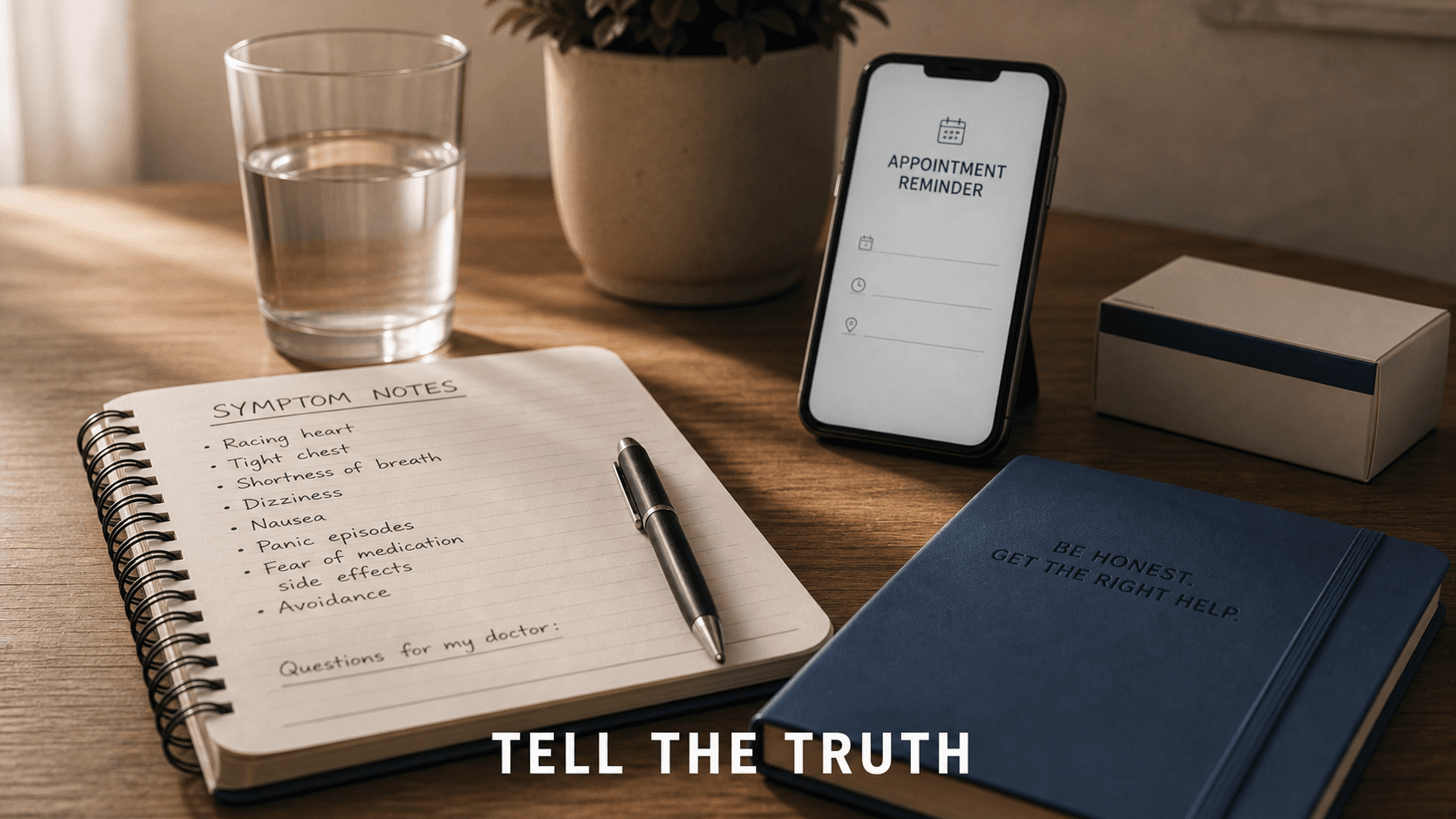
If I could go back, I would have told the doctor plainly:
- I bought the medication but did not start it
- I am afraid of side effects
- I am afraid of dependency
- I am afraid restarting means I failed
- I need you to explain the plan slowly
- I need to know what to do if panic spikes after starting
- I need a follow-up date, not just a prescription
That conversation would not have made everything easy. But it would have made the fear less hidden.
Hidden fear grows. Spoken fear can be worked with.
Healing Is Not a Straight Line
I used to imagine recovery as:
bad -> treatment -> good -> done forever
Real life looked more like:
better -> careless -> worse -> ask for help -> adjust -> learn -> repeat
That does not mean failure.
It means the nervous system is part of a living person, not a machine you repair once and never think about again.
Restarting support is not going back to zero.
It is picking up from experience.
What Helped Me Stay Steadier
For me, the big turning point was not one dramatic decision.
It was the slow return to basics:
- sleeping at a predictable time
- eating in a way that did not amplify body stress
- reducing doom-scrolling
- moving daily, even when it was small
- keeping my world a little quieter
- talking honestly instead of hiding
- treating professional care as support, not proof of weakness
These did not replace medical care.
They made care easier to participate in.
They helped my brain feel less like a battlefield and more like a place I could live in again.
When to Seek Professional or Urgent Support
Please seek professional help if anxiety, panic, medication fear, or avoidance starts affecting your sleep, work, relationships, eating, ability to leave home, or daily functioning.
Speak with a clinician before starting, stopping, restarting, or changing prescribed medication, especially antidepressants, benzodiazepines, sleep medicines, or medicines taken daily for mental health.
Seek urgent help now if you have:
- thoughts of harming yourself or someone else
- suicidal thoughts, plans, or impulses
- panic symptoms with chest pain, fainting, severe shortness of breath, or new neurological symptoms
- severe withdrawal symptoms after stopping medication or substances
- confusion, extreme agitation, hallucinations, or behavior that feels unsafe
If you are in the United States and feel at risk of self-harm, call or text 988 for the Suicide & Crisis Lifeline. If you are elsewhere, contact your local emergency number or crisis service.
Where I Am Today
I still have anxiety sometimes.
I still get that old fear-flash now and then.
But I understand something now that I wish I had understood earlier:
Needing support does not mean you are weak. It means you are willing to stay alive, stay honest, and keep participating in your own care.
If you are reading this while staring at your own next step, I will say this gently:
You do not have to decide your whole future today.
You just have to take one honest step.
Even if that step is simply telling the truth.
Related Reading
- When Strangers Feel Unsafe but Friends Feel Like Home
- Brain Fog Is Not Just Tiredness: What People Actually Experience and What Slowly Helps
References
- NIMH: Anxiety Disorders
- Mayo Clinic: Antidepressant Withdrawal
- FDA: Boxed Warning Updated to Improve Safe Use of Benzodiazepine Drug Class
- 988 Suicide & Crisis Lifeline
Disclaimer: This article is for educational purposes only and is not medical advice. Individual symptoms, risks, and treatment decisions vary. Always consult a qualified healthcare professional for diagnosis and personalized care. If you have severe, worsening, or emergency symptoms, seek urgent medical attention immediately.
Related Reading
Continue reading after The Time I Was Afraid of My Own Medication
GERD, Reflux, and the Fear Loop: What Took Me Years to Understand
A long-form lived-experience pillar on chronic reflux, nighttime pain, anticipatory anxiety, daily tradeoffs, and what helped create stability over time.
Living With a Dry Mouth, Burning Pain, and No Easy Answers
A lived experience of chronic dry mouth, burning pain, medication side effects, dental damage, broken sleep, and the slow search for safer support.
When the Mind Influences the Body: A Long Journey Through Unexplained Physical Symptoms
A deeply personal story of recurring physical symptoms that began in childhood and the long, confusing journey of trying to understand what was really happening.
Share on WhatsApp
2–3 line summary is copied. Tap to open WhatsApp and share.
 Tip: You can edit the text after it opens in WhatsApp.
Editorial Note
This article is prepared by the HealthUnspoken Editorial Team. Our articles may combine first-person submissions, public health education references, and commonly discussed experiences, then are edited for clarity and context.
The goal is reader awareness and education. This content is not a diagnosis or a treatment plan.
⚕️ Medical Disclaimer
The information provided in this article is for **educational and informational purposes only**. It should not be considered medical advice, diagnosis, or treatment. Always seek the advice of your physician or other qualified healthcare provider regarding any medical condition or treatment decisions.
🧾 Sources
HealthUnspoken articles may include first-person stories, editorial summaries of broadly discussed experiences, and public health education references. They are reviewed by the editorial team for clarity and educational context.
Reader Experiences Shared
Curated anonymized snippets from public health discussions, edited for readability.
I kept thinking time i afraid would settle on its own, but what helped most was tracking patterns and asking clearer questions in appointments.
The hardest part for me was uncertainty around time i afraid. Once I stopped changing everything at once, I could finally see what was helping.
I used to delay care because I was embarrassed about time i afraid. Earlier conversations would have saved me a lot of stress.
A second opinion around time i afraid changed my decisions completely. The issue was still real, but the plan felt calmer and more practical.
For me, progress with time i afraid came from boring consistency, not one dramatic fix. That mindset reduced panic a lot.
I learned to separate fear from facts with time i afraid. Writing down symptoms before visits made discussions more useful.