
It Wasnt Just Anxiety How Understanding Neurodivergence Changed My Life
- Authors

- Name
- Author: HealthUnspoken Editorial Team
- Published on
- Last updated:
- Country
- Country
- 🌍Country: USA
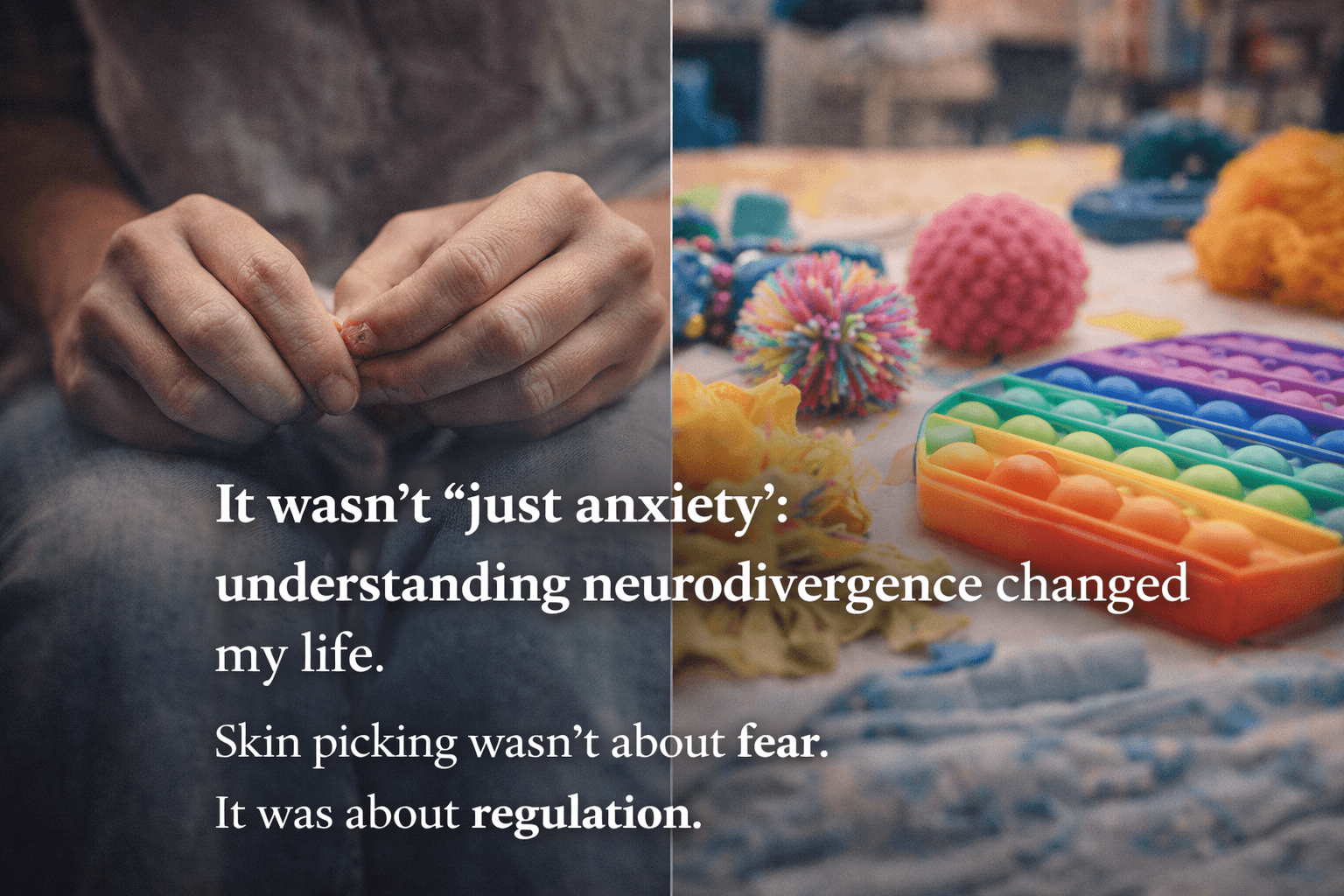
For years, the explanation was always anxiety. Anxiety about school. Anxiety about people. Anxiety about getting things wrong. That label explained part of my experience, but never the whole shape of it. It did not explain why my mind felt crowded all the time, why ordinary transitions knocked me sideways, or why skin picking felt less like a choice and more like a pressure valve.
Once I understood my brain through a neurodivergent lens, the story did not become simple.
It became coherent.
What Looked Like a Bad Habit Was Doing a Job
Skin picking is easy for other people to misread.
From the outside it can look like carelessness, self-damage, poor self-control, or a nervous habit that should disappear if the person just tries harder. That framing misses the lived experience completely.
For me, the behavior often showed up when my system was overloaded:
- too much sensory input
- too much internal noise
- too much social effort
- too much unprocessed tension
The act itself narrowed my focus. It gave my brain one point to lock onto when everything else felt too loud. That does not make it harmless, but it does make it understandable.
If you treat a regulation behavior as only a moral failure, you miss the problem that keeps feeding it.
The Mental Noise Was Constant
My mind did not rest easily.
Thoughts moved fast. Sounds felt louder than they seemed to for other people. Small disruptions could throw off my whole internal rhythm. Social situations took more energy than anyone could see.
Because I was quiet, none of that was obvious.
That is part of why some neurodivergent girls and women get missed for so long. The distress is not always disruptive. It can look like:
- compliance
- good grades with hidden exhaustion
- politeness
- intense self-monitoring
- recovering alone after appearing fine
Outwardly stable does not always mean internally manageable.
The Cost of Masking
I learned early how to study other people and imitate what looked natural for them.
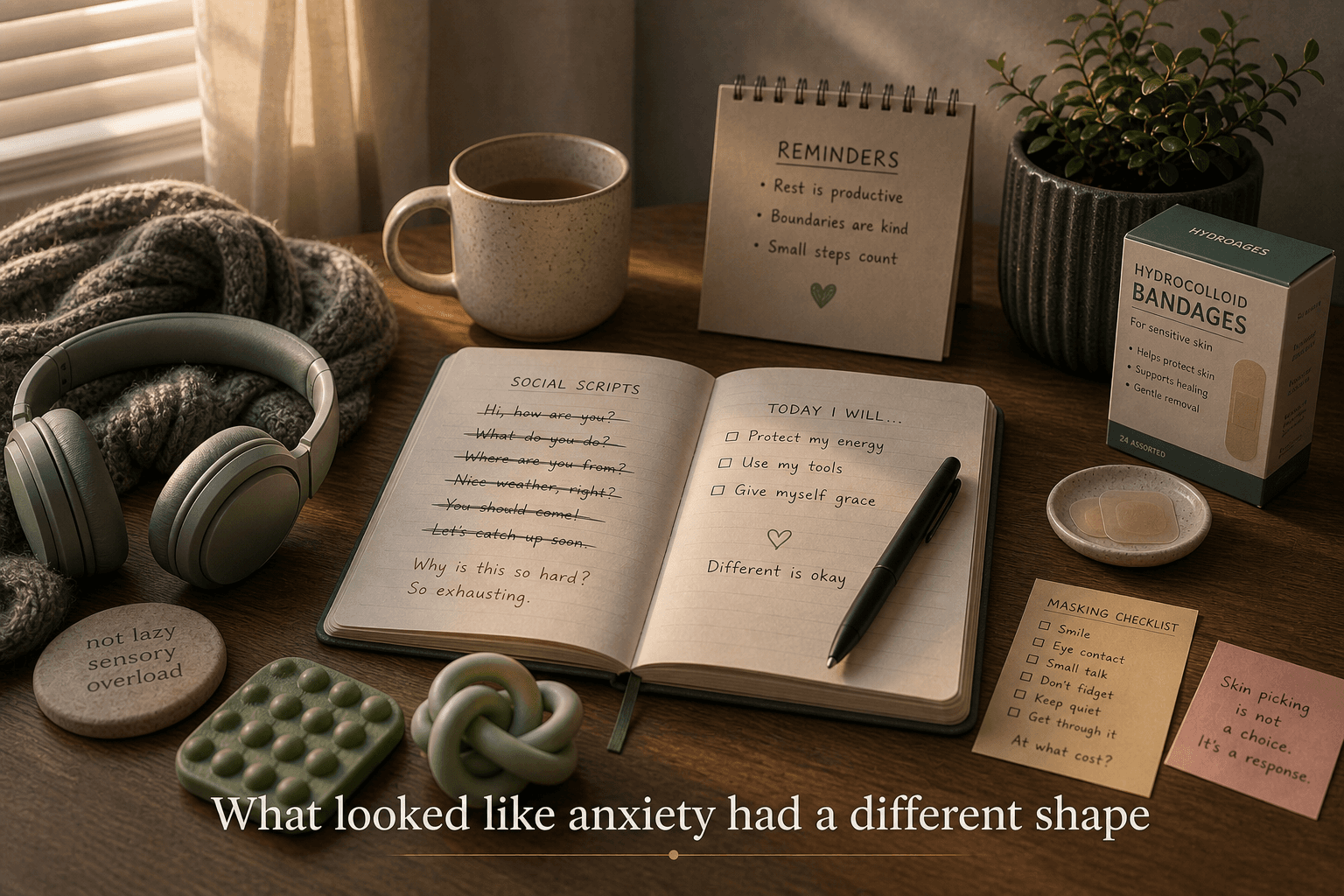
I rehearsed conversations. I monitored eye contact. I edited my reactions. I tried to hide the movements and preferences that made me feel more regulated. Over time that became second nature.
Masking can help a person survive socially. It can also become exhausting enough to distort the whole picture.
When a clinician sees someone who is articulate, self-aware, and outwardly composed, they may miss how much energy is being spent on appearing manageable.
The result is a painful split:
- other people see "doing okay"
- the person inside feels close to overload
What the Comment Patterns Suggested
I pulled bounded MySQL samples before rewriting this article. The first pass brought in too much broad autism and ADHD chatter, so I tightened the query toward masking, late diagnosis, sensory overload, skin picking, and excoriation language.
The usable patterns were still clear:
- many people spent years under anxiety or depression labels that only partly fit
- many described the exhaustion of performing normality rather than simply being themselves
- some talked about repetitive behaviors or body-focused habits as regulation, not self-harm
- some found practical support only after autism or ADHD was considered seriously
- people disagreed intensely about medication, which reinforced the need for a more careful middle ground
That last point matters.
Neurodivergence content online is full of overstatement. Some people talk as if medication solves everything. Others talk as if diagnosis alone solves everything. Neither matches what I experienced.
The Wrong Framework Created the Wrong Help
When everything was framed as anxiety, the help I received was shaped around fear reduction.
Sometimes that was useful. Anxiety was real. But it was not the only thing happening.
The deeper issue was often overload:
- too many inputs
- too much unpredictability
- too little recovery time
- too much effort spent translating myself into acceptable behavior
That is why years of trying to "calm down" never fully resolved the problem. I was not only afraid. I was flooded.
That difference changed everything.
Late Diagnosis Did Not Feel Like Bad News
When I was finally assessed more broadly, I expected to feel broken in a new way.
Instead, I felt relief.
Autism and ADHD did not erase my past, but they reorganized it. Events that had once looked random started making sense:
- why transitions hit so hard
- why social recovery took so long
- why intense focus could coexist with apparent disorganization
- why sensory stress kept leaking out through repetitive behavior
- why shame had piled up so quickly around things I could not explain
The diagnosis did not give me a trendy identity.
It gave me a working map.
What Help Changed Once the Picture Changed
This was the most important shift.
The goal stopped being "make the symptoms disappear so I can act normal."
The goal became:
build a life that asks less impossible performance from my nervous system.
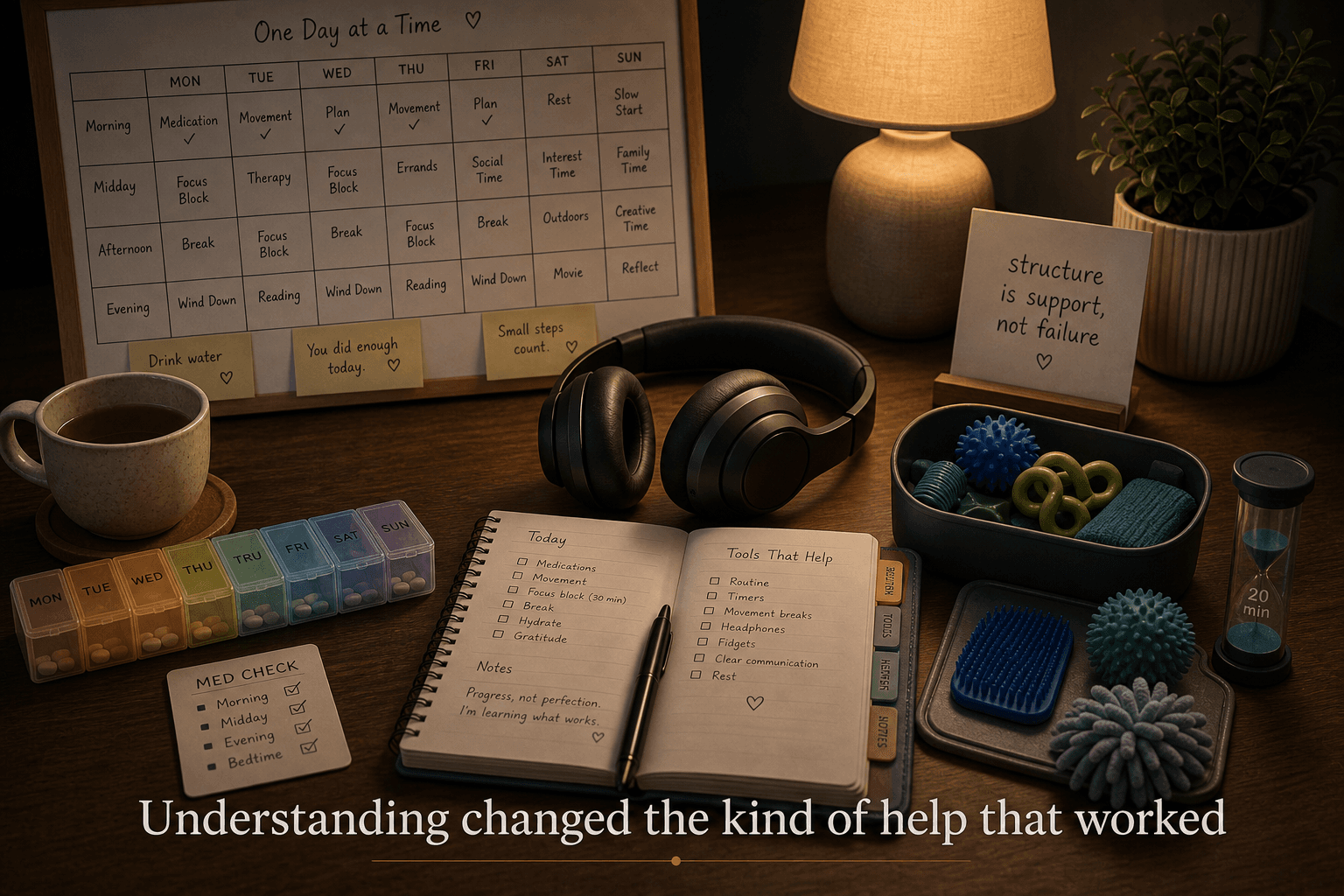
That meant more concrete supports:
- clearer routines
- predictable transitions
- sensory tools without shame
- movement breaks
- better language for overload
- less forcing eye contact or social scripts when they drained me
- more honest pacing
For some people, medication is part of that. For some, therapy is central. For some, the biggest change is environmental and relational. Usually it is a combination.
Skin Picking Needed Compassion and Strategy
Understanding the behavior did not automatically stop it.
That is another place where people get discouraged. Insight matters, but it is not a substitute for support.
What helped more was treating skin picking as a pattern with triggers:
- fatigue
- mirror time
- idle hands
- sensory roughness
- social recovery after overload
- long unstructured time
Once I saw those patterns more clearly, the response could become practical:
- cover or protect vulnerable skin when needed
- reduce specific triggers
- give the hands another job
- shorten the periods where overload built quietly
- work with professionals who understood body-focused repetitive behaviors
Compassion mattered too. Shame was never an effective regulator for me.
What I Wish More People Understood
Neurodivergence is not just a list of traits. It changes the daily cost of ordinary life.
A person may look capable and still be spending a punishing amount of energy on:
- translating social expectations
- filtering noise
- enduring texture discomfort
- staying organized
- hiding repetitive behavior
- recovering from interactions other people forget quickly
That is why late understanding can feel so profound. It does not invent the struggle. It names it.
And once something is named accurately, the help can finally become more accurate too.
When Professional Help Matters
Please seek qualified mental health or medical support if you have:
- skin picking that causes bleeding, infection, scarring, or major distress
- severe anxiety or depression
- self-harm thoughts
- burnout so intense that daily life is breaking down
- attention, sensory, or social struggles affecting school, work, safety, or relationships
- confusion about whether autism, ADHD, OCD, trauma, or another condition may be involved
Formal assessment can be helpful, especially when a person has spent years being partially explained but not fully understood.
What Changed Most
The biggest difference was not that I suddenly became easy for the world to understand.
It was that I stopped using the wrong explanation against myself.
I was not lazy. I was not weak. I was not failing at being a normal person on purpose.
What looked like anxiety had a different shape. Once I saw that shape clearly, I could stop fighting myself and start building support that fit.
That was the beginning of something much more useful than self-criticism.
It was the beginning of traction.
References
- National Institute of Mental Health: Autism Spectrum Disorder
- National Institute of Mental Health: Attention-Deficit/Hyperactivity Disorder
- NHS: Skin Picking Disorder
Related HealthUnspoken Reading
- Anxiety symptoms and overlap with body signals
- Living with body-focused repetitive behaviors in silence
Disclaimer: This article is for educational purposes only and is not medical advice. It does not diagnose autism, ADHD, excoriation disorder, or any other mental health condition. If you are dealing with skin picking, overload, depression, self-harm thoughts, or major daily impairment, please seek help from a qualified clinician.
Related Reading
Continue reading after It Wasnt Just Anxiety How Understanding Neurodivergence Changed My Life
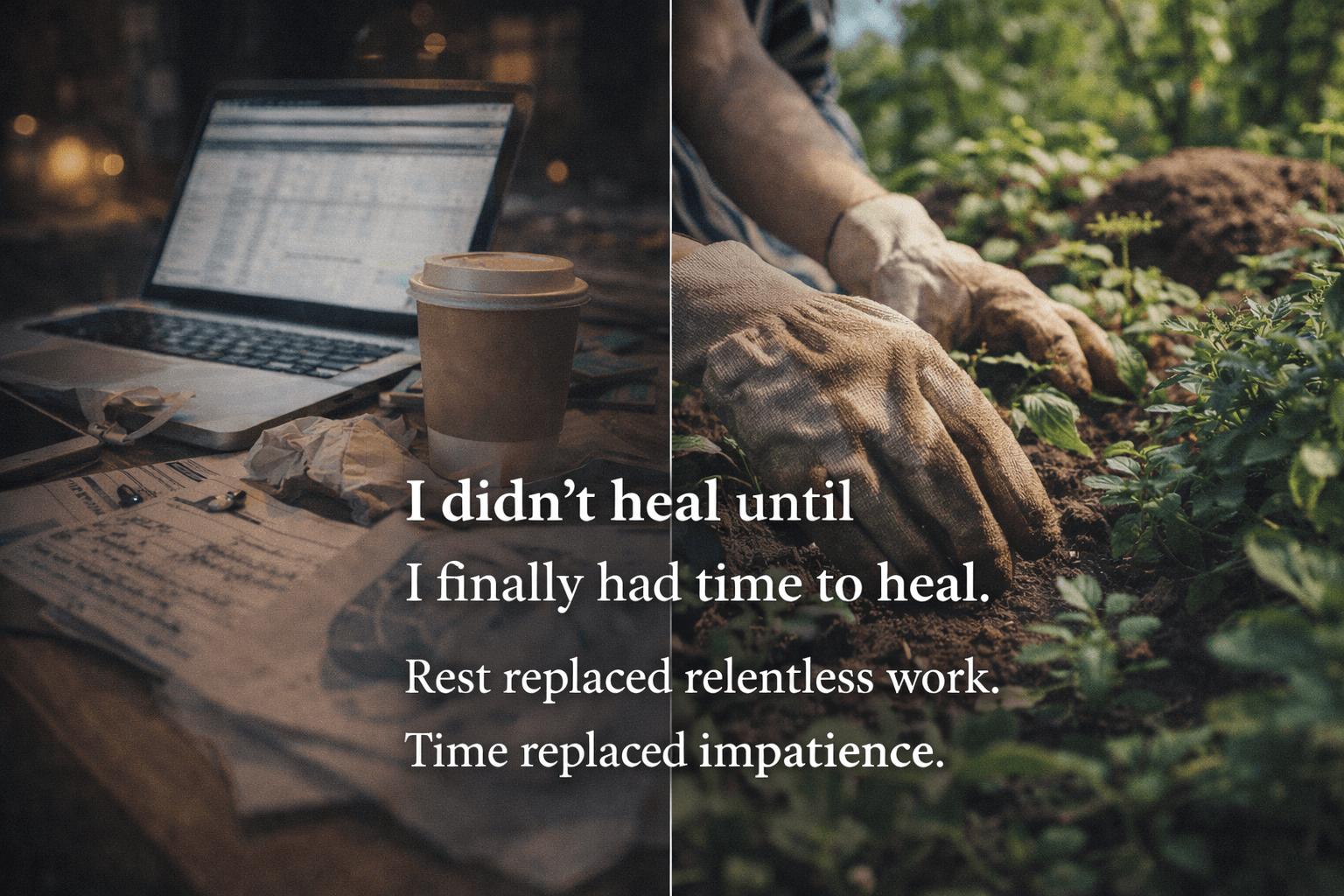
I Didnt Heal Until I Finally Had Time to Heal
A de-identified personal story about chronic pain, constant work urgency, burnout, nervous-system exhaustion, and the slower kind of recovery that only started once rest became real instead of theoretical.
Living With a Dry Mouth, Burning Pain, and No Easy Answers
A lived experience of chronic dry mouth, burning pain, medication side effects, dental damage, broken sleep, and the slow search for safer support.

Two Hip Replacements, Twenty Years Apart and the Quiet Miracle of Living Without Pain
I lived through two hip replacements separated by twenty years. What changed was not only medicine but how pain, preparation, therapy and resilience reshaped my life.
Share on WhatsApp
2–3 line summary is copied. Tap to open WhatsApp and share.
 Tip: You can edit the text after it opens in WhatsApp.
Editorial Note
This article is prepared by the HealthUnspoken Editorial Team. Our articles may combine first-person submissions, public health education references, and commonly discussed experiences, then are edited for clarity and context.
The goal is reader awareness and education. This content is not a diagnosis or a treatment plan.
⚕️ Medical Disclaimer
The information provided in this article is for **educational and informational purposes only**. It should not be considered medical advice, diagnosis, or treatment. Always seek the advice of your physician or other qualified healthcare provider regarding any medical condition or treatment decisions.
🧾 Sources
HealthUnspoken articles may include first-person stories, editorial summaries of broadly discussed experiences, and public health education references. They are reviewed by the editorial team for clarity and educational context.
Reader Experiences Shared
Curated anonymized snippets from public health discussions, edited for readability.
I kept thinking neurodivergence would settle on its own, but what helped most was tracking patterns and asking clearer questions in appointments.
The hardest part for me was uncertainty around neurodivergence. Once I stopped changing everything at once, I could finally see what was helping.
I used to delay care because I was embarrassed about neurodivergence. Earlier conversations would have saved me a lot of stress.
A second opinion around neurodivergence changed my decisions completely. The issue was still real, but the plan felt calmer and more practical.
For me, progress with neurodivergence came from boring consistency, not one dramatic fix. That mindset reduced panic a lot.
I learned to separate fear from facts with neurodivergence. Writing down symptoms before visits made discussions more useful.