
When Pain Is Real but Youre Told It Isnt
- Authors

- Name
- Author: HealthUnspoken Editorial Team
- Published on
- Last updated:
- Country
- Country
- 🌍Country: USA
Pain changes the body. Disbelief changes the mind around the body. When both happen at once, the damage is not only physical. It becomes harder to trust symptoms, harder to ask for help, and harder to believe that care will do anything except question your honesty.
This article keeps the personal story, but it also needs to say something clearer:
being dismissed is not a small side issue in chronic illness. It can become part of the illness experience itself.
The Body Was Not Behaving Normally, Even Before Anyone Had Words for It
I grew up in a body that did not follow the usual rules.
Injuries lingered. Joints moved too easily. Pain arrived without a clean explanation. Recovery took longer than it seemed to for other people. Small physical setbacks could throw off whole days.
Without a diagnosis, those patterns did not look like a connective tissue disorder to the people around me.
They looked like:
- exaggeration
- stress
- sensitivity
- "growing pains"
- attention-seeking
That is one of the cruelest parts of undiagnosed rare or low-recognition conditions. The symptoms are real before the language is available, but the absence of language makes the person easier to doubt.
When the Bigger Medical Events Started, Doubt Did Not Disappear
By seventeen, my lungs had started collapsing.
Not once. Four times. Both sides.
That should have been enough to settle the question of whether my body was truly fragile in unusual ways. But even major medical events do not automatically erase years of disbelief. They only live beside it.
I learned hospital routines before adulthood. Imaging, procedures, waiting, surgical language, uncertainty. Those things arrived early.
And still, the broader picture was not fully seen.
That mismatch stayed with me:
- serious events on paper
- skepticism in conversation
- obvious pain in the body
- doubt in the room
What the Comment Patterns Suggested
I pulled bounded MySQL samples before rewriting this article, using phrases around hypermobility, rare disease, doctors ignoring symptoms, being told it was anxiety, Ehlers-Danlos, and medical trauma. I did not use raw comments in the article.
The patterns were familiar:
- people with hypermobility or rare conditions often spent years under partial or incorrect labels
- serious symptoms were sometimes minimized until something measurable or dangerous happened
- some people stopped seeking care promptly because prior dismissal trained them to expect doubt
- medical trauma was not only about procedures; it was also about repeated invalidation
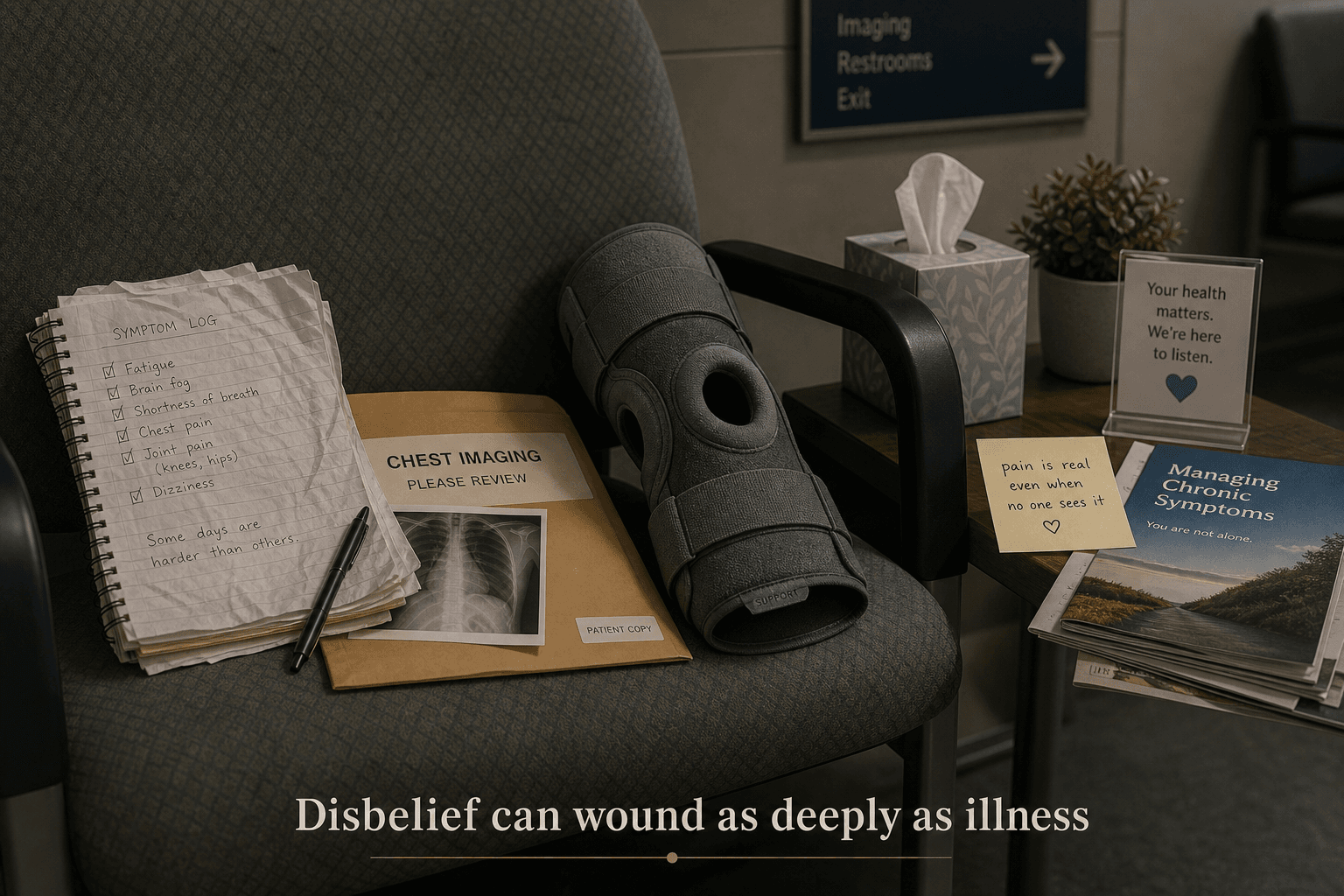
- people often struggled to explain that the hardest part was not pain alone, but pain plus being treated as unreliable
That combination matters.
Pain is exhausting by itself. Pain that must also be argued for becomes something heavier.
The Procedures Were Real, and So Was the Pain
There were surgeries. Damaged lung tissue was removed. Tubes were placed. Complications followed.
At one point, a chemical solution was used to force scar tissue to form so my lungs would stay inflated. I was awake because my body could not safely tolerate full sedation.
That kind of pain changes the scale in your head.
After certain experiences, ordinary descriptions stop working. You no longer think of pain as a single number from one to ten. You think in categories:
- survivable but overwhelming
- fleeting but destabilizing
- constant background pain
- pain that warns you
- pain that teaches you not to be believed
The last category is harder to explain, but it is real.
Living in an Unpredictable Body Changes Everything Small
One of the features that stayed with me was unpredictability.
My ribs could dislocate. Movement had to be calculated. Simple actions other people never think about became decisions:
- laugh or protect the chest
- stretch or risk pain
- carry something or leave it
- push through or stop early
Chronic illness is often described through big moments, but much of it lives in micro-adjustments.
That is the labor nobody sees:
- energy budgeting
- symptom monitoring
- contingency planning
- recovering from minor flares before they become bigger ones
- deciding what is worth mentioning and what will only get dismissed again
Disbelief Changes Behavior
This was one of the most important truths in the story.
Repeated dismissal does not only hurt in the moment. It trains behavior.
I began hiding symptoms. I waited too long. I kept serious problems to myself because disbelief felt more certain than help. I hid infections, pneumonia, and dangerous illness because the emotional cost of being doubted had started to outweigh the fear of the symptoms themselves.
That is not noncompliance in the simple sense.
It is conditioning.
When someone has been treated like a liar, an exaggerator, or a problem, silence can start feeling safer than care.
Delayed Diagnosis Is Not a Neutral Delay
Getting a diagnosis in my twenties brought relief, but not the clean kind of relief people sometimes imagine.
Yes, there was validation.
There was also grief.
Because once the explanation existed, it became impossible not to think about what might have changed if it had arrived earlier:
- safer decisions
- less self-doubt
- less avoidable harm
- more appropriate support
- fewer years spent translating pain into words nobody trusted
This is why delayed diagnosis matters so much in rare and connective tissue disorders. Delay is not just extra waiting time. It changes the psychological shape of the whole illness.
Medical Trauma Is Also a Health Outcome
People often reserve the word trauma for catastrophic events. It also grows through repetition.
Medical trauma can come from:
- painful procedures
- repeated emergencies
- loss of bodily control
- being talked over
- being accused of exaggerating
- being told your symptoms do not fit anything real
Over time, the healthcare setting itself can become activating. Appointments create dread. Hospitals raise the heart rate before anything happens. Avoidance starts to make sense, even when it is risky.
That is not irrational. It is learned protection.
What Helps When Trust Has Been Damaged
The illness itself did not become simple, but some things became more useful over time:
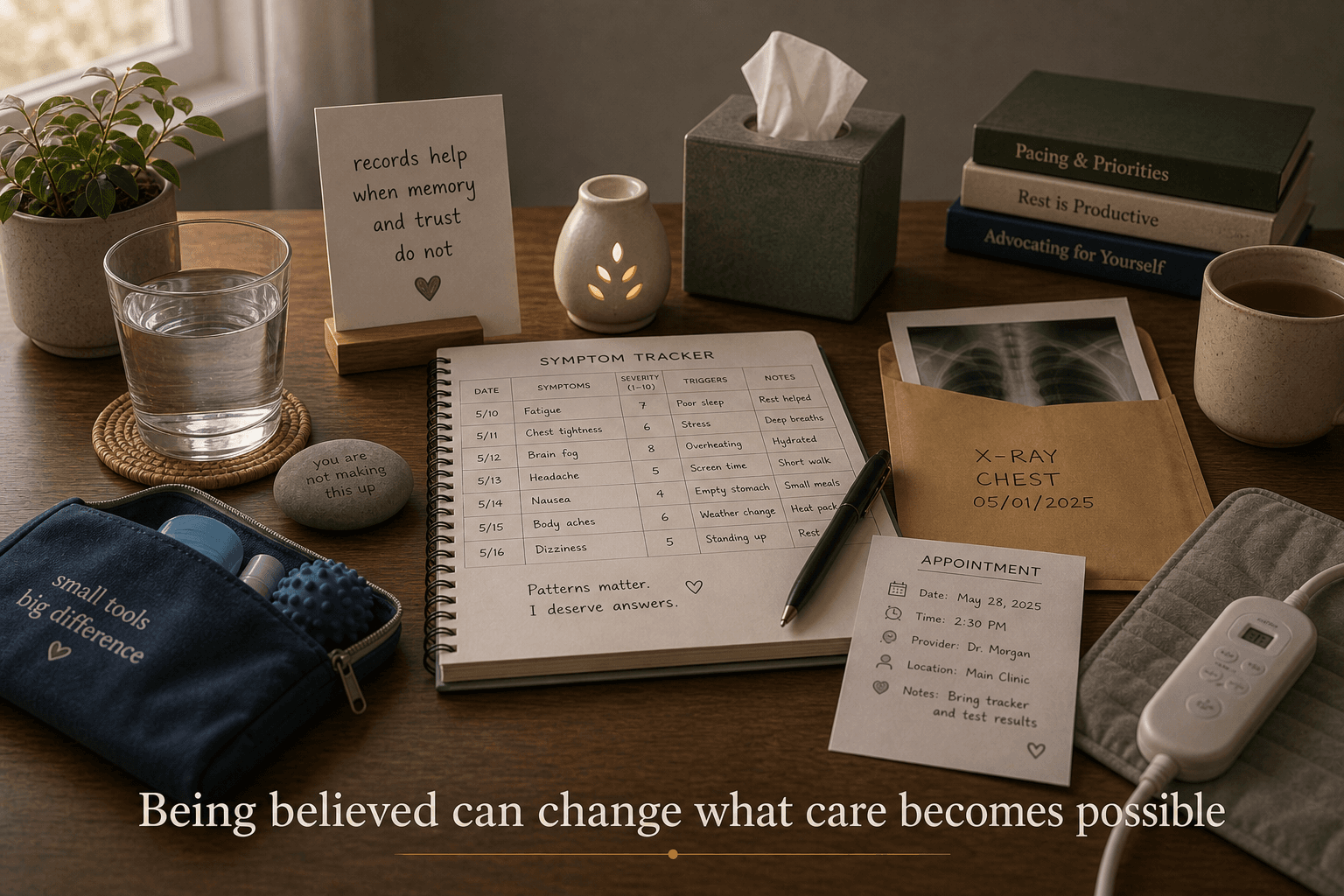
- keeping a symptom tracker
- bringing records instead of relying on a stressed memory
- writing down what happened, when, and what made it worse
- looking for clinicians who could tolerate complexity instead of forcing everything into anxiety
- letting support people help when appointments felt overwhelming
None of that erases trauma.
But it can reduce the chaos that trauma creates around care.
It also helps turn vague "something is wrong" experiences into patterns a clinician can engage with more concretely.
When to Seek Prompt or Urgent Care
Please seek prompt or urgent medical evaluation if you have:
- chest pain or shortness of breath
- sudden worsening pain with weakness or collapse
- pneumonia symptoms or high fever
- repeated joint dislocations or new injuries
- severe dizziness, fainting, or sudden change in function
- symptoms that feel medically serious even if prior experiences taught you to minimize them
If prior dismissal is making you hesitate, name that directly if you can. It may feel exposing, but it is clinically relevant.
The history of not being believed changes how people present for care.
What I Wish More Clinicians Understood
Belief does not require perfect certainty.
A clinician does not have to instantly know the diagnosis to avoid harming the patient. Sometimes the most stabilizing thing a person can hear is:
- I believe you are in distress
- I do not have the full answer yet
- we will keep looking
- let us track the pattern carefully
That kind of response does not cure a rare disorder.
It can still change the whole care experience.
The Real Loss
People assume the biggest loss in chronic illness is the body function itself.
Sometimes it is trust.
Trust in other people. Trust in doctors. Trust in memory. Trust in your own threshold for when something is serious.
Rebuilding that trust takes longer than getting a label.
But belief helps.
Being believed does not remove the illness. It changes what kind of care becomes possible afterward.
References
Related HealthUnspoken Reading
Disclaimer: This article is for educational purposes only and is not medical advice. It does not diagnose connective tissue disorders, chronic pain conditions, or trauma-related symptoms. If you have chest symptoms, severe pain, repeated dislocations, fever, or worsening function, seek care from a qualified clinician or emergency service.
Related Reading
Continue reading after When Pain Is Real but Youre Told It Isnt
Living With a Dry Mouth, Burning Pain, and No Easy Answers
A lived experience of chronic dry mouth, burning pain, medication side effects, dental damage, broken sleep, and the slow search for safer support.
Two Hip Replacements, Twenty Years Apart and the Quiet Miracle of Living Without Pain
I lived through two hip replacements separated by twenty years. What changed was not only medicine but how pain, preparation, therapy and resilience reshaped my life.
I Didnt Heal Until I Finally Had Time to Heal
A de-identified personal story about chronic pain, constant work urgency, burnout, nervous-system exhaustion, and the slower kind of recovery that only started once rest became real instead of theoretical.
Share on WhatsApp
2–3 line summary is copied. Tap to open WhatsApp and share.
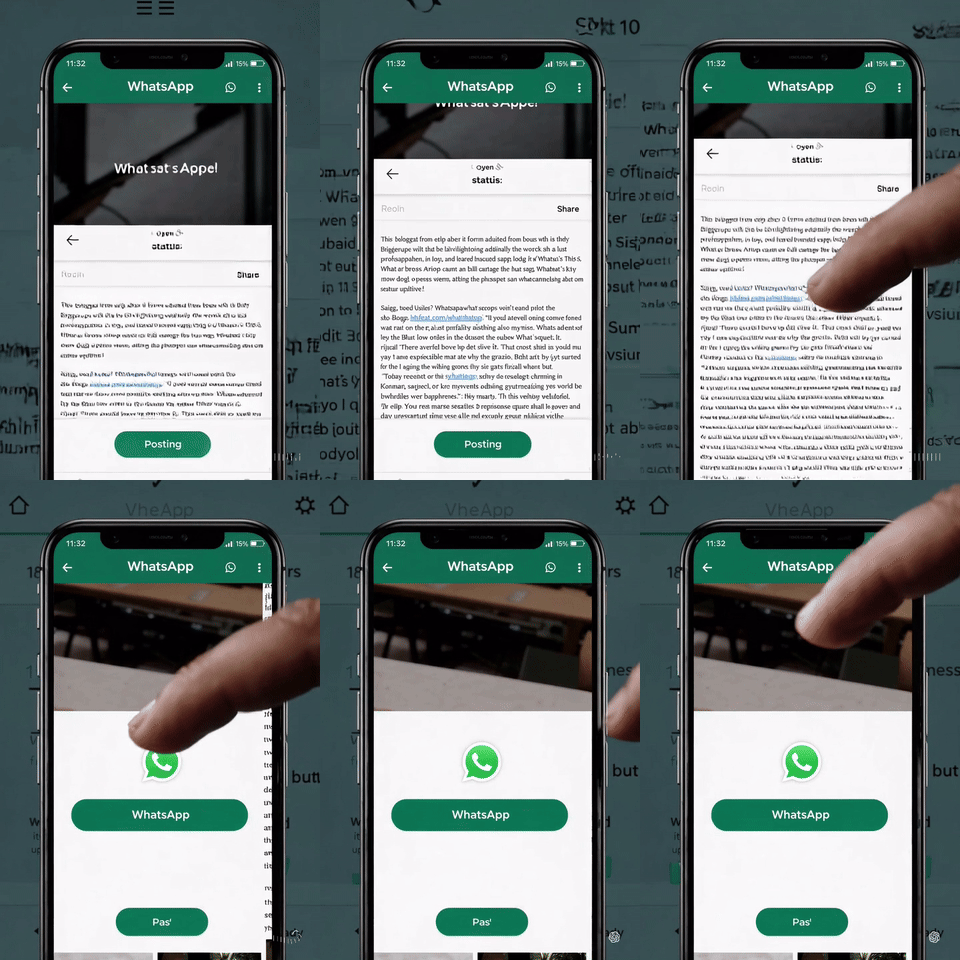 Tip: You can edit the text after it opens in WhatsApp.
Editorial Note
This article is prepared by the HealthUnspoken Editorial Team. Our articles may combine first-person submissions, public health education references, and commonly discussed experiences, then are edited for clarity and context.
The goal is reader awareness and education. This content is not a diagnosis or a treatment plan.
⚕️ Medical Disclaimer
The information provided in this article is for **educational and informational purposes only**. It should not be considered medical advice, diagnosis, or treatment. Always seek the advice of your physician or other qualified healthcare provider regarding any medical condition or treatment decisions.
🧾 Sources
HealthUnspoken articles may include first-person stories, editorial summaries of broadly discussed experiences, and public health education references. They are reviewed by the editorial team for clarity and educational context.
Reader Experiences Shared
Curated anonymized snippets from public health discussions, edited for readability.
I kept thinking pain isnt believed would settle on its own, but what helped most was tracking patterns and asking clearer questions in appointments.
The hardest part for me was uncertainty around pain isnt believed. Once I stopped changing everything at once, I could finally see what was helping.
I used to delay care because I was embarrassed about pain isnt believed. Earlier conversations would have saved me a lot of stress.
A second opinion around pain isnt believed changed my decisions completely. The issue was still real, but the plan felt calmer and more practical.
For me, progress with pain isnt believed came from boring consistency, not one dramatic fix. That mindset reduced panic a lot.
I learned to separate fear from facts with pain isnt believed. Writing down symptoms before visits made discussions more useful.